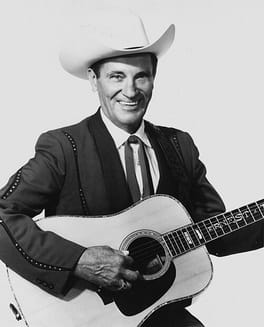
Photo: Atlas Artist Bureau / Public domain (source: Wikimedia Commons)
Public records list Ernest Tubb as a singer-songwriter, musician and singer. Ernest Tubb was born on February 9, 1914 in Crisp, Texas, United States. Death is recorded on September 6, 1984, at the age of 70. Awards on record include star on Hollywood Walk of Fame.
My Take
Ernest Tubb genuinely moves me. The Texas Troubadour was a founding pillar of country music, and "Walking the Floor Over You" did nothing less than usher in the honky-tonk era. What I love is that he won hearts not through vocal pyrotechnics but through plainspoken, beer-joint-floor honesty, the sound of real working life. Singer, songwriter, composer, even actor, his range was remarkable, and that star on the Hollywood Walk of Fame feels thoroughly earned. Though he passed in 1984, his voice still hums beneath modern country as part of its very foundation. To me he is a quietly towering figure.
This take was written by generative AI, one per person, from publicly reported facts (editorial policy). It is a reading of the record, not reporting.
1. Profile
- Name (English)
- Ernest Tubb
- Name (Japanese)
- アーネスト・タブ
- Reading
- あーねすと・たぶ
- Born
- February 9, 1914 – September 6, 1984
- Origin
- Crisp, Texas, United States
- Occupation
- singer-songwriter / musician / singer / composer / actor
- Zodiac / Chinese zodiac
- Aquarius / Tiger
2. Background
Awards & achievements
- star on Hollywood Walk of Fame
3. Links
- Wikipedia (English)https://en.wikipedia.org/wiki/Ernest%20Tubb
- Wikipedia (Japanese)https://ja.wikipedia.org/wiki/%E3%82%A2%E3%83%BC%E3%83%8D%E3%82%B9%E3%83%88%E3%83%BB%E3%82%BF%E3%83%96
- Wikidatahttps://www.wikidata.org/wiki/Q963142
4. About this entry
Tags
- Last updated
Facts are limited to publicly available information up to 2024; non-public or unconfirmed items are omitted. English text is machine-assisted (facts translated by Sonnet, "My Take" written by Opus 4.8). The Japanese page is the source of record.
Frequently asked questions
When was Ernest Tubb born?
Born February 9, 1914.
When did Ernest Tubb die?
Died September 6, 1984, aged 70.
Where was Ernest Tubb from?
Ernest Tubb was from Crisp, Texas, United States.
What did Ernest Tubb do?
Ernest Tubb worked as singer-songwriter, musician, singer, composer, actor.
Singer-songwriter — see all → · Musician — see all → · More people from the United States →