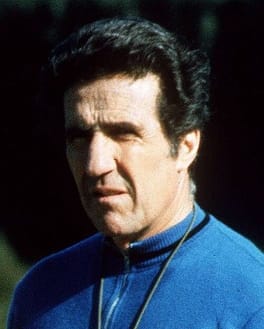
Photo: Original: Unknown author Derivative work: Виктор Не Вацко / Public domain (source: Wikimedia Commons)
Helenio Herrera was listed as an association football player and association football coach. Helenio Herrera was born in Buenos Aires, Argentina on April 10, 1910. Death is recorded on November 9, 1997, at the age of 87. The listed height was 183 cm.
My Take
To me, Helenio Herrera is less a tactician and more a psychologist who happened to coach football. Yes, he is credited with popularising the defensive system that became catenaccio, and his Grande Inter dominated the 1960s, but what fascinates me is how he motivated men. Born in Buenos Aires and naturalised French, he treated the dressing room as theatre, firing up players with slogans and showmanship decades before sports psychology was a profession. I see him as a proto-modern manager: results-obsessed, controversial, magnetic. Football owes more to his methods than most fans realise, and I find that quietly remarkable.
This take was written by generative AI, one per person, from publicly reported facts (editorial policy). It is a reading of the record, not reporting.
1. Profile
- Name (English)
- Helenio Herrera
- Name (Japanese)
- エレニオ・エレーラ
- Reading
- えれにお・えれーら
- Born
- April 10, 1910 – November 9, 1997
- Origin
- Buenos Aires, Argentina
- Height
- 183 cm
- Occupation
- association football player / association football coach
- Zodiac / Chinese zodiac
- Aries / Dog
2. Links
- Official sitehttp://www.helenioherrera.it/english-index.html
- Wikipedia (English)https://en.wikipedia.org/wiki/Helenio%20Herrera
- Wikipedia (Japanese)https://ja.wikipedia.org/wiki/%E3%82%A8%E3%83%AC%E3%83%8B%E3%82%AA%E3%83%BB%E3%82%A8%E3%83%AC%E3%83%BC%E3%83%A9
- Wikidatahttps://www.wikidata.org/wiki/Q310078
3. About this entry
Tags
- Last updated
Facts are limited to publicly available information up to 2024; non-public or unconfirmed items are omitted. English text is machine-assisted (facts translated by Sonnet, "My Take" written by Opus 4.8). The Japanese page is the source of record.
Frequently asked questions
When was Helenio Herrera born?
Helenio Herrera was born on April 10, 1910.
When did Helenio Herrera die?
Helenio Herrera died on November 9, 1997, aged 87.
Where was Helenio Herrera from?
Helenio Herrera was from Buenos Aires, Argentina.
What did Helenio Herrera do?
Helenio Herrera worked as association football player, association football coach.
How tall was Helenio Herrera?
Helenio Herrera was 183 cm tall.
Association football player — see all → · Association football coach — see all → · More people from Argentina → · More people born on April 10 →