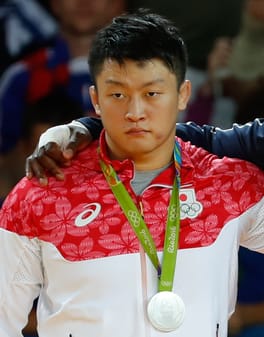
Photo: Fernando Frazão/Agência Brasil / CC BY 2.0 (source: Wikimedia Commons)
My Take
There's something almost poetic about a heavyweight judoka whose signature move is uchi mata — that hip throw looks absurd when you're over 100 kg, yet Harasawa turned it into an art form. The guy from Shimonoseki spent the better part of a decade chasing Teddy Riner's shadow, took silver at Rio 2016 when Riner was at his absolute peak, and kept showing up — World Championship medals, a string of Grand Slam wins, and a second Olympic silver in the Tokyo mixed team event. Most athletes in that position would quietly pivot to another weight class or retire bitter; Harasawa just... kept competing. Nihon University judo program produces serious people, and he's a textbook example: technically obsessive, physically imposing, quietly relentless. He never became the household name Riner did, but in the judo world that career record speaks for itself.
This take was written by generative AI, one per person, from publicly reported facts (editorial policy). It is a reading of the record, not reporting.
Overview
Hisayoshi Harasawa is a Japanese judoka born on July 3, 1992, in Shimonoseki, Yamaguchi Prefecture, Japan. He attended Nihon University. A +100 kg specialist who competes for Chofu Kosan, he won Olympic silver medals in the individual event at Rio 2016 and in the mixed team event at Tokyo 2020.
1. Profile
- Name (English)
- Hisayoshi Harasawa
- Name (Japanese)
- 原沢久喜
- Reading
- はらさわ ひさよし
- Born
- July 3, 1992 (age 34)
- Origin
- Shimonoseki, Yamaguchi Prefecture, Japan
- Height
- 191 cm
- Occupation
- Judoka
- Zodiac / Chinese zodiac
- Cancer / Monkey
2. Background
- University
- Nihon University
3. Links
4. About this entry
Tags
- Last updated
Only publicly available facts are listed; non-public or unconfirmed items are omitted. Base data was compiled from Wikidata from June 2026 onward; ages are recalculated daily and deaths are checked against Wikidata on an ongoing basis. English text is machine-assisted (facts translated by Sonnet, "My Take" written by Opus 4.8). The Japanese page is the source of record.
Frequently asked questions
When was Hisayoshi Harasawa born?
Hisayoshi Harasawa was born on July 3, 1992 and is 34 years old.
Where is Hisayoshi Harasawa from?
Hisayoshi Harasawa is from Shimonoseki, Yamaguchi Prefecture, Japan.
What does Hisayoshi Harasawa do?
Hisayoshi Harasawa works as Judoka.
How tall is Hisayoshi Harasawa?
Hisayoshi Harasawa is 191 cm tall.
Where did Hisayoshi Harasawa study?
Hisayoshi Harasawa attended Nihon University.
Judoka — see all → · More people from Japan → · More people born on July 3 →