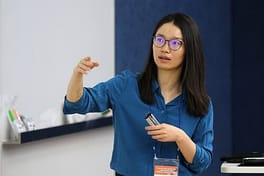
Photo: Rickinasia / CC0 (source: Wikimedia Commons)
Public records list Hong Wang as a mathematician. Hong Wang studied at Peking University. Recorded honors include Maryam Mirzakhani New Frontiers Prize (2022), Sadosky Prize, Ostrowski Prize and 1 more.
My Take
Hong Wang fascinates me because she operates at the dizzying frontier of Fourier analysis and geometric measure theory, fields most of us can barely pronounce. Born in 1991 in Guilin, she has already collected the Mirzakhani New Frontiers Prize, the Salem Prize and the Ostrowski Prize, and in 2026 the Fields Medal. What moves me is not the trophy cabinet but the quiet obsession it implies: years of wrestling with problems invisible to the rest of us. I admire mathematicians precisely because their fame is hard-won and rarely loud, and Wang strikes me as one of the most luminous of her generation.
This take was written by generative AI, one per person, from publicly reported facts (editorial policy). It is a reading of the record, not reporting.
1. Profile
- Name (English)
- Hong Wang
- Name (Japanese)
- 王虹
- Reading
- おう・こう
- Born
- 1991
- Origin
- Guilin, People's Republic of China
- Occupation
- mathematician
- Zodiac / Chinese zodiac
- Goat
2. Background
- University
- Peking University
Awards & achievements
- 2022 Maryam Mirzakhani New Frontiers Prize
- Sadosky Prize
- Ostrowski Prize
- International Congress of Chinese Mathematicians
3. Links
- Official sitehttps://sites.google.com/view/hongwang/home
- Wikipedia (English)https://en.wikipedia.org/wiki/Hong%20Wang
- Wikipedia (Japanese)https://ja.wikipedia.org/wiki/%E7%8E%8B%E8%99%B9
- Wikidatahttps://www.wikidata.org/wiki/Q132968784
4. About this entry
Tags
- Last updated
Facts are limited to publicly available information up to 2024; non-public or unconfirmed items are omitted. English text is machine-assisted (facts translated by Sonnet, "My Take" written by Opus 4.8). The Japanese page is the source of record.
Frequently asked questions
Where is Hong Wang from?
Hong Wang is from Guilin, People's Republic of China.
What does Hong Wang do?
Hong Wang works as mathematician.
Where did Hong Wang study?
Hong Wang attended Peking University.
Mathematician — see all → · More people from the People's Republic of China →