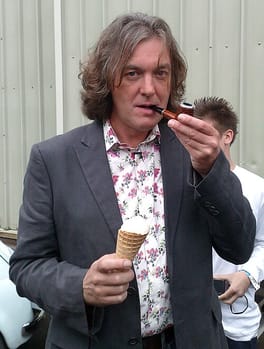
Photo: Ignitedfirestarter / CC BY-SA 3.0 (source: Wikimedia Commons)
James May was born on January 16, 1963 in Bristol, Avon, United Kingdom. Public records list James May as a television presenter, journalist and writer. The age as of 2026 is 63. Education on record includes Oakwood High School and University of Lancaster. Notable works include Top Gear and The Grand Tour.
My Take
James May is genuinely one of my favorite TV personalities, and I think he's massively underrated compared to the louder chaos his co-hosts bring. He spent over a decade on Top Gear alongside Jeremy Clarkson and Richard Hammond, and where those two were constantly crashing and yelling, May was the one quietly building a working hovercraft or delivering an unexpectedly moving piece about a classic car. He's got a music degree from Lancaster University, writes books, and clearly thinks deeply about engineering and craft — this is not a guy who stumbled into car television. The Grand Tour gave him a proper second act on Amazon Prime through 2024, and he never lost that wonderfully unhurried, deadpan quality. I respect anyone who refuses to be rushed by the world around them, and May has made an entire career out of exactly that.
This take was written by generative AI, one per person, from publicly reported facts (editorial policy). It is a reading of the record, not reporting.
1. Profile
- Name (English)
- James May
- Name (Japanese)
- ジェームズ・メイ
- Reading
- じぇーむず・めい
- Born
- January 16, 1963 (age 63)
- Origin
- Bristol, Avon, United Kingdom
- Occupation
- television presenter / journalist / writer / musician / broadcaster
- Zodiac / Chinese zodiac
- Capricorn / Rabbit
2. Background
- High school
- Oakwood High School
- University
- University of Lancaster
3. Works & records
Filmography / notable works
| Category | Title |
|---|---|
| Notable work | Top Gear |
| Notable work | The Grand Tour |
4. Links
- Instagramhttps://www.instagram.com/jamesmaybloke/
- Xhttps://x.com/MrJamesMay
- Wikipedia (English)https://en.wikipedia.org/wiki/James%20May
- Wikipedia (Japanese)https://ja.wikipedia.org/wiki/%E3%82%B8%E3%82%A7%E3%83%BC%E3%83%A0%E3%82%BA%E3%83%BB%E3%83%A1%E3%82%A4
- Wikidatahttps://www.wikidata.org/wiki/Q314504
5. About this entry
Tags
- Last updated
Only publicly available facts are listed; non-public or unconfirmed items are omitted. Base data was compiled from Wikidata from June 2026 onward; ages are recalculated daily and deaths are checked against Wikidata on an ongoing basis. English text is machine-assisted (facts translated by Sonnet, "My Take" written by Opus 4.8). The Japanese page is the source of record.
Frequently asked questions
When was James May born?
James May was born on January 16, 1963 and is 63 years old.
Where is James May from?
James May is from Bristol, Avon, United Kingdom.
What does James May do?
James May works as television presenter, journalist, writer, musician, broadcaster.
Where did James May study?
James May attended University of Lancaster.
What is James May known for?
James May's notable works include Top Gear, The Grand Tour.
Television presenter — see all → · Journalist — see all → · More people from the United Kingdom → · More people born on January 16 →