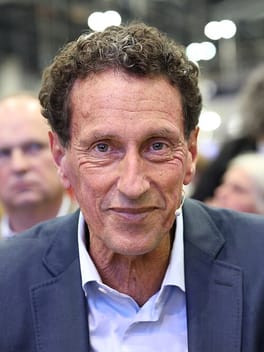
Photo: C.Stadler/Bwag / CC BY-SA 4.0 (source: Wikimedia Commons)
Public records list Julian Nida-Rümelin as a philosopher, university teacher and politician. Julian Nida-Rümelin was born on November 28, 1954 in Munich, Upper Bavaria, Germany. That works out to 71 years old in 2026. Education on record includes University of Tübingen. Listed accolades include Bavarian Order of Merit, honorary doctor of the University of Trier and BigBrotherAwards (2021).
My Take
Julian Nida-Rümelin is the kind of public intellectual I genuinely admire: a philosopher who refused to stay safely inside the seminar room. Serving as Germany's State Minister for Culture under Schröder meant testing abstract ideas against the grind of real politics, which takes a particular kind of nerve. As vice chairman of the German Ethics Council, he asks what it means to be human at exactly the moment technology keeps blurring that line. Even the ironic BigBrotherAward feels telling, here is someone willing to provoke. In an age that prizes loud certainty, his patient, principled questioning strikes me as quietly essential.
This take was written by generative AI, one per person, from publicly reported facts (editorial policy). It is a reading of the record, not reporting.
1. Profile
- Name (English)
- Julian Nida-Rümelin
- Name (Japanese)
- ユリアン・ニーダ・リューメリン
- Reading
- ゆりあん・にーだ・りゅーめりん
- Born
- November 28, 1954 (age 71)
- Origin
- Munich, Upper Bavaria, Germany
- Occupation
- philosopher / university teacher / politician / German Minister of State
- Zodiac / Chinese zodiac
- Sagittarius / Horse
2. Background
- University
- University of Tübingen
Awards & achievements
- Bavarian Order of Merit
- honorary doctor of the University of Trier
- 2021 BigBrotherAwards
3. Links
- Xhttps://x.com/Nida_Ruemelin
- Wikipedia (English)https://en.wikipedia.org/wiki/Julian%20Nida-R%C3%BCmelin
- Wikipedia (Japanese)https://ja.wikipedia.org/wiki/%E3%83%A6%E3%83%AA%E3%82%A2%E3%83%B3%E3%83%BB%E3%83%8B%E3%83%BC%E3%83%80%E3%83%BB%E3%83%AA%E3%83%A5%E3%83%BC%E3%83%A1%E3%83%AA%E3%83%B3
- Wikidatahttps://www.wikidata.org/wiki/Q91865
4. About this entry
Tags
- Last updated
Facts are limited to publicly available information up to 2024; non-public or unconfirmed items are omitted. English text is machine-assisted (facts translated by Sonnet, "My Take" written by Opus 4.8). The Japanese page is the source of record.
Frequently asked questions
When was Julian Nida-Rümelin born?
Born November 28, 1954 (age 71).
Where is Julian Nida-Rümelin from?
Julian Nida-Rümelin is from Munich, Upper Bavaria, Germany.
What does Julian Nida-Rümelin do?
Julian Nida-Rümelin works as philosopher, university teacher, politician, German Minister of State.
Philosopher — see all → · University teacher — see all → · More people from Germany →