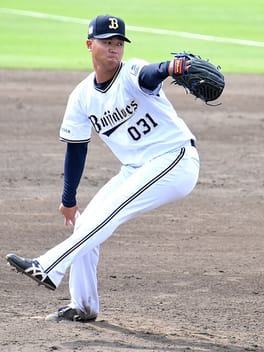
Photo: Revenge red / CC BY-SA 4.0 (source: Wikimedia Commons)
My Take
I'll be honest, I don't have a deep stat sheet on Kaito Saiki in front of me, but the shape of his story already grabs me. Here's an Osaka kid, born in Toyonaka in 2000, who packed up and went all the way to Hokkaido for high school baseball before circling back home to Osaka University of Economics and turning pro. That out-and-back arc tells me something: he chased the grind where it was coldest and toughest, then came home to prove it. I love a player like that, the kind who builds quietly instead of arriving fully formed. I'm rooting for him to keep climbing.
This take was written by generative AI, one per person, from publicly reported facts (editorial policy). It is a reading of the record, not reporting.
Overview
Kaito Saiki is a Japanese professional baseball player born on June 10, 2000, in Toyonaka, Osaka Prefecture. He attended Hokkaido Ei High School before going on to study at Osaka University of Economics. His blood type and agency affiliation are not publicly disclosed.
1. Profile
- Name (English)
- Kaito Saiki
- Name (Japanese)
- 才木海翔
- Reading
- さいき かいと
- Born
- June 10, 2000 (age 26)
- Origin
- Toyonaka, Osaka Prefecture, Japan
- Occupation
- Baseball player
- Zodiac / Chinese zodiac
- Gemini / Dragon
2. Background
- High school
- Hokkaido Ei High School
- University
- Osaka University of Economics
3. Links
- Instagramhttps://www.instagram.com/orix__95/
- Wikipedia (Japanese)https://ja.wikipedia.org/wiki/%E6%89%8D%E6%9C%A8%E6%B5%B7%E7%BF%94
- Wikidatahttps://www.wikidata.org/wiki/Q121354661
4. About this entry
Tags
- Last updated
Facts are limited to publicly available information up to 2024; non-public or unconfirmed items are omitted. English text is machine-assisted (facts translated by Sonnet, "My Take" written by Opus 4.8). The Japanese page is the source of record.
Frequently asked questions
When was Kaito Saiki born?
Born June 10, 2000 (age 26).
Where is Kaito Saiki from?
Kaito Saiki is from Toyonaka, Osaka Prefecture, Japan.
What does Kaito Saiki do?
Kaito Saiki works as Baseball player.