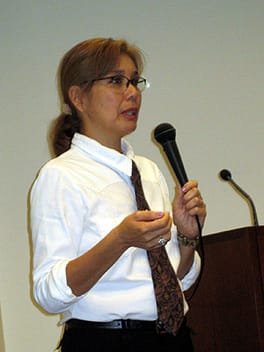
Photo: Bytemarks from Honolulu, USA / CC BY 2.0 (source: Wikimedia Commons)
Keiko Bonk is a politician, fashion designer and artist, born on July 13, 1954. That puts Keiko Bonk at 72 years old in 2026. Schooling on record includes Hunter College.
My Take
Keiko Bonk strikes me as a genuinely rare figure, someone who refuses to be confined to a single lane. An artist, musician, and former politician based in Hawaii, she co-founded the state's Green Party and became the first person in North America elected to partisan office under the Green Party banner. In a country where most local races are nonpartisan, choosing to run under a clear ideological flag and winning reflects real conviction. With a Hunter College background in art and design feeding into her politics, she treats creativity and civic life as one continuous practice. I deeply respect people who live that boundary-blurring way.
This take was written by generative AI, one per person, from publicly reported facts (editorial policy). It is a reading of the record, not reporting.
1. Profile
- Name (English)
- Keiko Bonk
- Name (Japanese)
- ケイコ・バンク
- Reading
- けいこ・ばんく
- Born
- July 13, 1954 (age 72)
- Occupation
- politician / fashion designer / artist / musician
- Zodiac / Chinese zodiac
- Cancer / Horse
2. Background
- University
- Hunter College
3. Links
- Wikipedia (English)https://en.wikipedia.org/wiki/Keiko%20Bonk
- Wikipedia (Japanese)https://ja.wikipedia.org/wiki/%E3%82%B1%E3%82%A4%E3%82%B3%E3%83%BB%E3%83%90%E3%83%B3%E3%82%AF
- Wikidatahttps://www.wikidata.org/wiki/Q6383670
4. About this entry
Tags
- Last updated
Facts are limited to publicly available information up to 2024; non-public or unconfirmed items are omitted. English text is machine-assisted (facts translated by Sonnet, "My Take" written by Opus 4.8). The Japanese page is the source of record.
Frequently asked questions
When was Keiko Bonk born?
Born July 13, 1954 (age 72).
What does Keiko Bonk do?
Keiko Bonk works as politician, fashion designer, artist, musician.