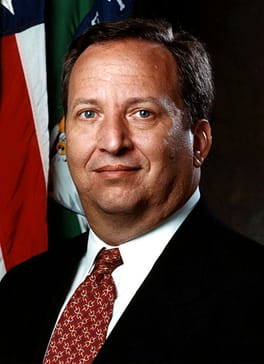
Photo: United States Department of Treasury / Public domain (source: Wikimedia Commons)
Lawrence Summers is listed as an economist, university teacher and professor. Lawrence Summers was born in New Haven, Connecticut, United States on November 30, 1954. That works out to 71 years old in 2026. Education on record includes Harriton High School and Harvard University. Listed accolades include John Bates Clark Medal (1993), Adam Smith Award (2009), Alan T. Waterman Award (1987) and 5 more.
My Take
Lawrence Summers interests me as the rare economist who keeps walking into rooms where economists usually fear to tread. Treasury Secretary, Harvard president, National Economic Council director — each role demands a different kind of armor, and he wore them all while staying recognizably himself: brilliant, blunt, and allergic to consensus for its own sake. The John Bates Clark Medal confirmed his analytical firepower early, but what I respect more is his willingness to be publicly wrong rather than privately cautious. He generates controversy the way some people generate small talk, yet American economic debate would be thinner without him. To me, that trade-off is worth defending.
This take was written by generative AI, one per person, from publicly reported facts (editorial policy). It is a reading of the record, not reporting.
1. Profile
- Name (English)
- Lawrence Summers
- Name (Japanese)
- ローレンス・サマーズ
- Reading
- ろーれんす・さまーず
- Born
- November 30, 1954 (age 71)
- Origin
- New Haven, Connecticut, United States
- Occupation
- economist / university teacher / professor / scientist / politician
- Zodiac / Chinese zodiac
- Sagittarius / Horse
2. Background
- High school
- Harriton High School
- University
- Harvard University
Awards & achievements
- 1993 John Bates Clark Medal
- 2009 Adam Smith Award
- 1987 Alan T. Waterman Award
- 2000 Golden Plate Award
- 2011 Global Economy Prize
- 1985 Fellow of the Econometric Society
- 1987 Fellow of the American Academy of Arts and Sciences
- 2007 honorary doctor of Harvard University
3. Links
4. About this entry
Tags
- Last updated
Facts are limited to publicly available information up to 2024; non-public or unconfirmed items are omitted. English text is machine-assisted (facts translated by Sonnet, "My Take" written by Opus 4.8). The Japanese page is the source of record.
Frequently asked questions
When was Lawrence Summers born?
Born November 30, 1954 (age 71).
Where is Lawrence Summers from?
Lawrence Summers is from New Haven, Connecticut, United States.
What does Lawrence Summers do?
Lawrence Summers works as economist, university teacher, professor, scientist, politician.
Economist — see all → · University teacher — see all → · More people from the United States →