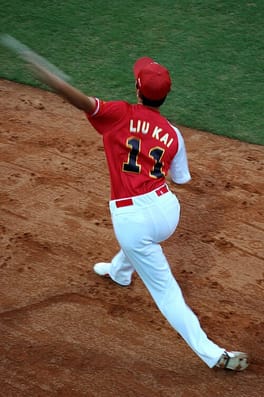
Photo: User West Zest on Flickr / CC BY-SA 2.0 (source: Wikimedia Commons)
Born on October 11, 1987, Liu Kai is from Tianjin, People's Republic of China. Liu Kai is credited as a baseball player. The age as of 2026 is 38.
My Take
Liu Kai is a footnote with real weight. A left-handed pitcher from Tianjin who entered a Chinese sports school at twelve and made it into the New York Yankees organization, he represents an early chapter in China's reach toward Major League Baseball. He was eventually released from the minors alongside countryman Zhang Zhenwang, and that's where many would close the book. I read it differently. Crossing the Pacific to wear a Yankees affiliate's uniform, in an era when Chinese pitchers were rare, is itself a small act of trailblazing. The outcome matters less to me than the door he helped nudge open.
This take was written by generative AI, one per person, from publicly reported facts (editorial policy). It is a reading of the record, not reporting.
1. Profile
- Name (English)
- Liu Kai
- Name (Japanese)
- 劉凱
- Reading
- りゅう・がい
- Born
- October 11, 1987 (age 38)
- Origin
- Tianjin, People's Republic of China
- Occupation
- baseball player
- Zodiac / Chinese zodiac
- Libra / Rabbit
2. Links
- Wikipedia (English)https://en.wikipedia.org/wiki/Liu%20Kai%20(baseball)
- Wikipedia (Japanese)https://ja.wikipedia.org/wiki/%E5%8A%89%E5%87%B1
- Wikidatahttps://www.wikidata.org/wiki/Q3378914
3. About this entry
Tags
- Last updated
Facts are limited to publicly available information up to 2024; non-public or unconfirmed items are omitted. English text is machine-assisted (facts translated by Sonnet, "My Take" written by Opus 4.8). The Japanese page is the source of record.
Frequently asked questions
When was Liu Kai born?
Liu Kai was born on October 11, 1987 and is 38 years old.
Where is Liu Kai from?
Liu Kai is from Tianjin, People's Republic of China.
What does Liu Kai do?
Liu Kai works as baseball player.
Baseball player — see all → · More people from the People's Republic of China →