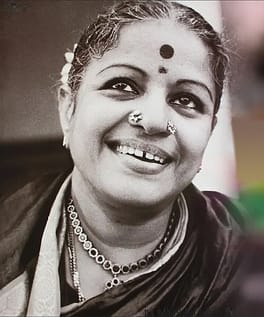
Photo: Saregama Carnatic / CC BY 3.0 (source: Wikimedia Commons)
Born on September 16, 1916, M. S. Subbulakshmi was from Madurai, Madurai district, India. M. S. Subbulakshmi was credited as a singer and film actor. Death is recorded on December 11, 2004, at the age of 88. Recorded honors include Sangeet Natak Akademi Award (1956), Ramon Magsaysay Award (1974), Padma Bhushan (1954) and 2 more.
My Take
M. S. Subbulakshmi is one of those rare figures whose name alone commands reverence. My take is that she did for Carnatic music what very few artists ever achieve for any art form: she made it a symbol of a nation. Becoming the first musician awarded the Bharat Ratna, and the first Indian to sing at the United Nations General Assembly in 1966, she carried devotion in her voice across the world. Though she also acted in film, I believe her true gift was turning song into prayer. Two decades after her death, that luminous voice still feels utterly immortal.
This take was written by generative AI, one per person, from publicly reported facts (editorial policy). It is a reading of the record, not reporting.
1. Profile
- Name (English)
- M. S. Subbulakshmi
- Name (Japanese)
- M.S.スッブラクシュミ
- Reading
- M.S.すっぶらくしゅみ
- Born
- September 16, 1916 – December 11, 2004
- Origin
- Madurai, Madurai district, India
- Occupation
- singer / film actor
- Zodiac / Chinese zodiac
- Virgo / Dragon
2. Background
Awards & achievements
- 1956 Sangeet Natak Akademi Award
- 1974 Ramon Magsaysay Award
- 1954 Padma Bhushan
- 1998 Bharat Ratna
- 1975 Padma Vibhushan
3. Links
- Wikipedia (English)https://en.wikipedia.org/wiki/M.%20S.%20Subbulakshmi
- Wikidatahttps://www.wikidata.org/wiki/Q465067
4. About this entry
Tags
- Last updated
Facts are limited to publicly available information up to 2024; non-public or unconfirmed items are omitted. English text is machine-assisted (facts translated by Sonnet, "My Take" written by Opus 4.8). The Japanese page is the source of record.
Frequently asked questions
When was M. S. Subbulakshmi born?
M. S. Subbulakshmi was born on September 16, 1916.
When did M. S. Subbulakshmi die?
M. S. Subbulakshmi died on December 11, 2004, aged 88.
Where was M. S. Subbulakshmi from?
M. S. Subbulakshmi was from Madurai, Madurai district, India.
What did M. S. Subbulakshmi do?
M. S. Subbulakshmi worked as singer, film actor.
Singer — see all → · Film actor — see all → · More people from India → · More people born on September 16 →