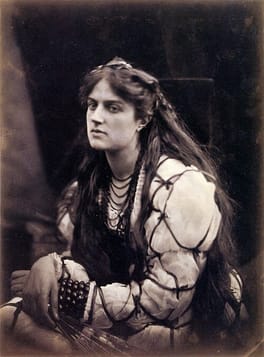
Photo: Julia Margaret Cameron / Public domain (source: Wikimedia Commons)
Marie Spartali Stillman was born in London, United Kingdom on March 10, 1844. Marie Spartali Stillman was credited as a painter and model. Death is recorded on March 6, 1927, at the age of 82. Credited works include Love's Messenger.
My Take
Marie Spartali Stillman fascinates me because she refused to stay on the canvas. Born in London in 1844 to a Greek family, she began as a Pre-Raphaelite model but became one of the movement's finest painters, often called the greatest woman artist of that circle. In an era when female artists were rarely taken seriously, she sustained a long career, with works like Love's Messenger glowing with that dreamlike Pre-Raphaelite beauty. Living to 1927, she kept creating across decades. I find her quiet persistence deeply moving, a reminder of how many overlooked women shaped art history.
This take was written by generative AI, one per person, from publicly reported facts (editorial policy). It is a reading of the record, not reporting.
1. Profile
- Name (English)
- Marie Spartali Stillman
- Name (Japanese)
- マリー・スパルタリ・スティルマン
- Reading
- まりー・すぱるたり・すてぃるまん
- Born
- March 10, 1844 – March 6, 1927
- Origin
- London, United Kingdom
- Occupation
- painter / model
- Zodiac / Chinese zodiac
- Pisces / Dragon
2. Works & records
Filmography / notable works
| Category | Title |
|---|---|
| Notable work | Love's Messenger |
3. Links
- Wikipedia (English)https://en.wikipedia.org/wiki/Marie%20Spartali%20Stillman
- Wikipedia (Japanese)https://ja.wikipedia.org/wiki/%E3%83%9E%E3%83%AA%E3%83%BC%E3%83%BB%E3%82%B9%E3%83%91%E3%83%AB%E3%82%BF%E3%83%AA%E3%83%BB%E3%82%B9%E3%83%86%E3%82%A3%E3%83%AB%E3%83%9E%E3%83%B3
- Wikidatahttps://www.wikidata.org/wiki/Q134150
4. About this entry
Tags
- Last updated
Facts are limited to publicly available information up to 2024; non-public or unconfirmed items are omitted. English text is machine-assisted (facts translated by Sonnet, "My Take" written by Opus 4.8). The Japanese page is the source of record.
Frequently asked questions
When was Marie Spartali Stillman born?
Born March 10, 1844.
When did Marie Spartali Stillman die?
Died March 6, 1927, aged 82.
Where was Marie Spartali Stillman from?
Marie Spartali Stillman was from London, United Kingdom.
What did Marie Spartali Stillman do?
Marie Spartali Stillman worked as painter, model.
What was Marie Spartali Stillman known for?
Notable works include Love's Messenger.
Painter — see all → · Model — see all → · More people from the United Kingdom →