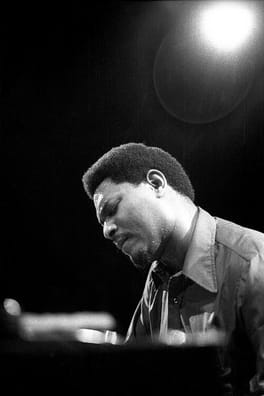
Photo: Copyright (c) 1973 Gisle Hannemyr / CC BY-SA 3.0 (source: Wikimedia Commons)
Born on December 11, 1938 in Philadelphia, Pennsylvania, United States, McCoy Tyner was a pianist, bandleader and composer. Death is recorded on March 6, 2020, at the age of 81. Recorded honors include NEA Jazz Masters.
My Take
McCoy Tyner is one of those pianists who genuinely changed what the piano could do in jazz — and I don't say that lightly. Growing up in Philadelphia and coming up through the Philly scene, he landed one of the most coveted gigs in jazz history when he joined John Coltrane's classic quartet in 1960, and those recordings from that era — A Love Supreme, My Favorite Things, Ballads — still hit like a freight train six decades later. What I love about Tyner is that his left hand alone could fill a room; those dense, thunderous fourths and fifths he voiced weren't just accompaniment, they were architecture. After leaving Coltrane in 1965 he kept building, winning five Grammys and earning NEA Jazz Master status, and his influence on essentially every serious jazz pianist who followed him is impossible to overstate. He passed in March 2020, but the sound he built is permanent.
This take was written by generative AI, one per person, from publicly reported facts (editorial policy). It is a reading of the record, not reporting.
1. Profile
- Name (English)
- McCoy Tyner
- Name (Japanese)
- マッコイ・タイナー
- Reading
- まっこい・たいなー
- Born
- December 11, 1938 – March 6, 2020
- Origin
- Philadelphia, Pennsylvania, United States
- Occupation
- pianist / bandleader / composer / conductor / jazz musician
- Zodiac / Chinese zodiac
- Sagittarius / Tiger
2. Background
Awards & achievements
- NEA Jazz Masters
3. Links
- Official sitehttps://www.mccoytyner.com/
- Wikipedia (English)https://en.wikipedia.org/wiki/McCoy%20Tyner
- Wikipedia (Japanese)https://ja.wikipedia.org/wiki/%E3%83%9E%E3%83%83%E3%82%B3%E3%82%A4%E3%83%BB%E3%82%BF%E3%82%A4%E3%83%8A%E3%83%BC
- Wikidatahttps://www.wikidata.org/wiki/Q318619
4. About this entry
Tags
- Last updated
Only publicly available facts are listed; non-public or unconfirmed items are omitted. Base data was compiled from Wikidata from June 2026 onward; ages are recalculated daily and deaths are checked against Wikidata on an ongoing basis. English text is machine-assisted (facts translated by Sonnet, "My Take" written by Opus 4.8). The Japanese page is the source of record.
Frequently asked questions
When was McCoy Tyner born?
McCoy Tyner was born on December 11, 1938.
When did McCoy Tyner die?
McCoy Tyner died on March 6, 2020, aged 81.
Where was McCoy Tyner from?
McCoy Tyner was from Philadelphia, Pennsylvania, United States.
What did McCoy Tyner do?
McCoy Tyner worked as pianist, bandleader, composer, conductor, jazz musician.
Pianist — see all → · Bandleader — see all → · More people from the United States → · More people born on December 11 →