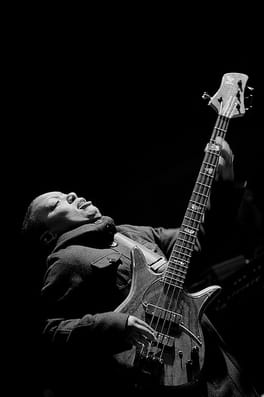
Photo: Yancho Sabev / CC BY-SA 3.0 (source: Wikimedia Commons)
Meshell Ndegeocello is a jazz guitarist, singer and singer-songwriter. Born on August 29, 1968, Meshell Ndegeocello is from Berlin, Germany. That works out to 58 years old in 2026. Education on record includes Oxon Hill High School. Awards on record include Grammy Award for Best R&B Song (2021).
My Take
To me, Meshell Ndegeocello is one of the most quietly fearless artists in modern music. She refuses to sit in a single genre, weaving funk, soul, jazz, hip hop and reggae into something unmistakably her own, often anchored by her remarkable bass playing. What I admire most is her patience: she never chased trends, yet her 2021 Grammy for Best R&B Song felt like long-overdue recognition of a singular voice. She is a poet as much as a musician, and that depth is exactly why artists like her matter more to me than any chart-topper.
This take was written by generative AI, one per person, from publicly reported facts (editorial policy). It is a reading of the record, not reporting.
1. Profile
- Name (English)
- Meshell Ndegeocello
- Name (Japanese)
- ミシェル・ンデゲオチェロ
- Reading
- みしぇる・んでげおちぇろ
- Born
- August 29, 1968 (age 58)
- Origin
- Berlin, Germany
- Occupation
- jazz guitarist / singer / singer-songwriter / rapper / bassist
- Zodiac / Chinese zodiac
- Virgo / Monkey
2. Background
- High school
- Oxon Hill High School
Awards & achievements
- 2021 Grammy Award for Best R&B Song
3. Works & records
Filmography / notable works
| Category | Title |
|---|---|
| Notable work | Weather |
4. Links
- Official sitehttps://meshell.com/
- Instagramhttps://www.instagram.com/officialmeshell/
- Xhttps://x.com/OfficialMeshell
- Wikipedia (English)https://en.wikipedia.org/wiki/Meshell%20Ndegeocello
- Wikipedia (Japanese)https://ja.wikipedia.org/wiki/%E3%83%9F%E3%82%B7%E3%82%A7%E3%83%AB%E3%83%BB%E3%83%B3%E3%83%87%E3%82%B2%E3%82%AA%E3%83%81%E3%82%A7%E3%83%AD
- Wikidatahttps://www.wikidata.org/wiki/Q72720
5. About this entry
Tags
- Last updated
Facts are limited to publicly available information up to 2024; non-public or unconfirmed items are omitted. English text is machine-assisted (facts translated by Sonnet, "My Take" written by Opus 4.8). The Japanese page is the source of record.
Frequently asked questions
When was Meshell Ndegeocello born?
Meshell Ndegeocello was born on August 29, 1968 and is 58 years old.
Where is Meshell Ndegeocello from?
Meshell Ndegeocello is from Berlin, Germany.
What does Meshell Ndegeocello do?
Meshell Ndegeocello works as jazz guitarist, singer, singer-songwriter, rapper, bassist.
Which high school did Meshell Ndegeocello attend?
Meshell Ndegeocello attended Oxon Hill High School.
What is Meshell Ndegeocello known for?
Meshell Ndegeocello's notable works include Weather.
Jazz guitarist — see all → · Singer — see all → · More people from Germany → · More people born on August 29 →