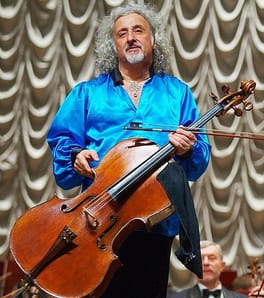
Photo: Victor Dmitriev / CC BY-SA 3.0 (source: Wikimedia Commons)
Born on January 10, 1948, Mischa Maisky is from Riga, Latvia. Mischa Maisky is listed as a cellist, conductor and music arranger. The age as of 2026 is 78. Recorded honors include Echo Klassik – Instrumentalist of the Year (2003).
My Take
Mischa Maisky is the kind of cellist who makes you forget you're listening to a classical concert — you're just watching a man have an intensely personal conversation with his instrument. Born in Riga in 1948, he studied under both Mstislav Rostropovich and Gregor Piatigorsky, which is essentially the Mt. Rushmore of cello pedagogy, and that lineage shows in every phrase he draws out. What I love about Maisky is that he never sounds polished in the sterile sense; his playing has this gorgeous roughness and emotional weight to it, an almost vocal quality that pulls you in. His Bach cello suites recordings are the ones I'd recommend to anyone who thinks classical music is cold or distant. The Echo Klassik award in 2003 was well deserved, but honestly, the real prize is just hearing him live — long hair flying, completely lost in the music.
This take was written by generative AI, one per person, from publicly reported facts (editorial policy). It is a reading of the record, not reporting.
1. Profile
- Name (English)
- Mischa Maisky
- Name (Japanese)
- ミッシャ・マイスキー
- Reading
- みっしゃ・まいすきー
- Born
- January 10, 1948 (age 78)
- Origin
- Riga, Latvia
- Occupation
- cellist / conductor / music arranger / musician
- Zodiac / Chinese zodiac
- Capricorn / Rat
2. Background
Awards & achievements
- 2003 Echo Klassik – Instrumentalist of the Year
3. Links
- Official sitehttp://www.mischamaisky.com/
- Wikipedia (English)https://en.wikipedia.org/wiki/Mischa%20Maisky
- Wikipedia (Japanese)https://ja.wikipedia.org/wiki/%E3%83%9F%E3%83%83%E3%82%B7%E3%83%A3%E3%83%BB%E3%83%9E%E3%82%A4%E3%82%B9%E3%82%AD%E3%83%BC
- Wikidatahttps://www.wikidata.org/wiki/Q381759
4. About this entry
Tags
- Last updated
Only publicly available facts are listed; non-public or unconfirmed items are omitted. Base data was compiled from Wikidata from June 2026 onward; ages are recalculated daily and deaths are checked against Wikidata on an ongoing basis. English text is machine-assisted (facts translated by Sonnet, "My Take" written by Opus 4.8). The Japanese page is the source of record.
Frequently asked questions
When was Mischa Maisky born?
Mischa Maisky was born on January 10, 1948 and is 78 years old.
Where is Mischa Maisky from?
Mischa Maisky is from Riga, Latvia.
What does Mischa Maisky do?
Mischa Maisky works as cellist, conductor, music arranger, musician.
Cellist — see all → · Conductor — see all → · More people from Latvia → · More people born on January 10 →