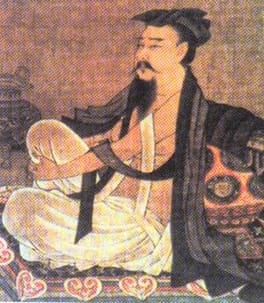
Photo: Unknown author / Public domain (source: Wikimedia Commons)
Public records list Ruan Ji as a writer, poet and philosopher. Ruan Ji died on 263.
My Take
Ruan Ji lived nearly eighteen centuries ago and yet the man feels startlingly modern to me — a brilliant, deeply uncomfortable misfit who used poetry and wine as armor against a world he found both absurd and dangerous. He came up during the chaotic collapse of the Han dynasty and spent his adult life navigating the lethal politics of the Wei court, where saying the wrong thing could get you killed. His response was to cultivate deliberate eccentricity: drunk, cryptic, pointedly apolitical. The result was some of the most searching lyric poetry in the Chinese tradition, his eighty-two "Poems from My Heart" circling loneliness, mortality, and the impossibility of integrity in a corrupt age. The guqin piece attributed to him — Drunken Ecstasy — captures the same energy: formally exquisite, secretly furious. I find him genuinely moving, this guy who decided that survival and dignity required playing the fool while thinking harder than anyone around him.
This take was written by generative AI, one per person, from publicly reported facts (editorial policy). It is a reading of the record, not reporting.
1. Profile
- Name (English)
- Ruan Ji
- Name (Japanese)
- 阮籍
- Reading
- げん せき
- Born
- 210 – 263
- Origin
- Kaifeng, People's Republic of China
- Occupation
- writer / poet / philosopher / composer
- Zodiac / Chinese zodiac
- Tiger
2. Links
- Wikipedia (English)https://en.wikipedia.org/wiki/Ruan%20Ji
- Wikipedia (Japanese)https://ja.wikipedia.org/wiki/%E9%98%AE%E7%B1%8D
- Wikidatahttps://www.wikidata.org/wiki/Q142683
3. About this entry
Tags
- Last updated
Only publicly available facts are listed; non-public or unconfirmed items are omitted. Base data was compiled from Wikidata from June 2026 onward; ages are recalculated daily and deaths are checked against Wikidata on an ongoing basis. English text is machine-assisted (facts translated by Sonnet, "My Take" written by Opus 4.8). The Japanese page is the source of record.
Frequently asked questions
Where was Ruan Ji from?
Ruan Ji was from Kaifeng, People's Republic of China.
What did Ruan Ji do?
Ruan Ji worked as writer, poet, philosopher, composer.
Writer — see all → · Poet — see all → · More people from the People's Republic of China →