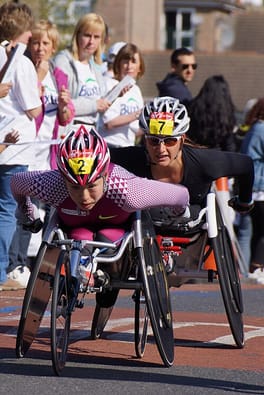
Photo: JULIAN MASON / CC BY 2.0 (source: Wikimedia Commons)
My Take
Wakako Tsuchida is the kind of athlete who makes you rethink what a career is supposed to look like. She lost both legs in a traffic accident at 18, and then spent the next three-plus decades quietly becoming one of the most decorated Paralympians Japan has ever produced — gold in Athens, five Boston Marathon wheelchair titles, Winter Games medals in sledge racing, the whole thing. What gets me is the range: she didn't just dominate one event or one era, she kept reinventing herself across sports and decades, right up to Paris 2024 where she raced in her seventh Games at 49. The marathon gold always eluded her and she knew it, and she went to Paris anyway. That's not stubbornness — that's a person who genuinely loves competing more than she needs the medal. One of those careers you respect more the longer you look at it.
This take was written by generative AI, one per person, from publicly reported facts (editorial policy). It is a reading of the record, not reporting.
Overview
Wakako Tsuchida is a Japanese track and field athlete born on October 15, 1974, in Tokyo, Japan. She has competed in athletics at an elite level, representing the perseverance and dedication characteristic of the sport. Standing 160 cm tall, she belongs to the generation of Japanese athletes who forged their careers through consistent training and long-term commitment to competitive athletics.
1. Profile
- Name (English)
- Wakako Tsuchida
- Name (Japanese)
- 土田和歌子
- Reading
- つちだ わかこ
- Born
- October 15, 1974 (age 51)
- Origin
- Tokyo, Japan
- Height
- 160cm
- Occupation
- Track and Field Athlete
- Zodiac / Chinese zodiac
- Libra / Tiger
2. Links
- Wikipedia (Japanese)https://ja.wikipedia.org/wiki/%E5%9C%9F%E7%94%B0%E5%92%8C%E6%AD%8C%E5%AD%90
- Wikidatahttps://www.wikidata.org/wiki/Q515552
3. About this entry
Tags
- Last updated
Facts are limited to publicly available information up to 2024; non-public or unconfirmed items are omitted. English text is machine-assisted (facts translated by Sonnet, "My Take" written by Opus 4.8). The Japanese page is the source of record.
Frequently asked questions
When was Wakako Tsuchida born?
Born October 15, 1974 (age 51).
Where is Wakako Tsuchida from?
Wakako Tsuchida is from Tokyo, Japan.
What does Wakako Tsuchida do?
Wakako Tsuchida works as Track and Field Athlete.
How tall is Wakako Tsuchida?
Wakako Tsuchida is 160 cm.
Track and Field Athlete — see all → · More people from Japan →