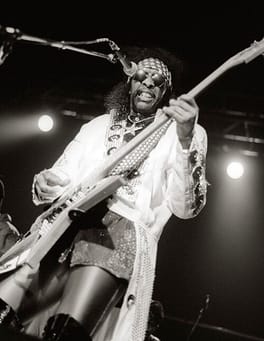
Photo: MikaV / CC BY-SA 4.0 (source: Wikimedia Commons)
Bootsy Collins is listed as a bassist, songwriter and singer. Bootsy Collins was born in Cincinnati, Ohio, United States on October 26, 1951. The age as of 2026 is 74.
My Take
For my money, Bootsy Collins is the rare virtuoso who never let virtuosity get in the way of joy. The discipline he absorbed playing behind James Brown gave him the foundation to go gloriously weird with Parliament-Funkadelic: the star-shaped bass, the space-cowboy outfits, basslines that wobble and snap like rubber. I love that combination of rigor and play, because you cannot fake either side of it. Plenty of bassists are technically flawless, but very few changed how the instrument feels. Bootsy made the bass a lead character, a comedian, and a heartbeat all at once. Modern funk simply does not exist in its current form without him.
This take was written by generative AI, one per person, from publicly reported facts (editorial policy). It is a reading of the record, not reporting.
1. Profile
- Name (English)
- Bootsy Collins
- Name (Japanese)
- ブーツィー・コリンズ
- Reading
- ぶーつぃー・こりんず
- Born
- October 26, 1951 (age 74)
- Origin
- Cincinnati, Ohio, United States
- Occupation
- bassist / songwriter / singer / guitarist
- Zodiac / Chinese zodiac
- Scorpio / Rabbit
2. Links
- Official sitehttps://www.bootsycollins.com
- Instagramhttps://www.instagram.com/bootsy_collins/
- Xhttps://x.com/Bootsy_Collins
- Wikipedia (English)https://en.wikipedia.org/wiki/Bootsy%20Collins
- Wikipedia (Japanese)https://ja.wikipedia.org/wiki/%E3%83%96%E3%83%BC%E3%83%84%E3%82%A3%E3%83%BC%E3%83%BB%E3%82%B3%E3%83%AA%E3%83%B3%E3%82%BA
- Wikidatahttps://www.wikidata.org/wiki/Q452411
3. About this entry
Tags
- Last updated
Facts are limited to publicly available information up to 2024; non-public or unconfirmed items are omitted. English text is machine-assisted (facts translated by Sonnet, "My Take" written by Opus 4.8). The Japanese page is the source of record.
Frequently asked questions
When was Bootsy Collins born?
Born October 26, 1951 (age 74).
Where is Bootsy Collins from?
Bootsy Collins is from Cincinnati, Ohio, United States.
What does Bootsy Collins do?
Bootsy Collins works as bassist, songwriter, singer, guitarist.
Bassist — see all → · Songwriter — see all → · More people from the United States →