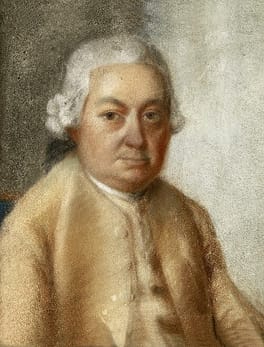
Photo: After Johann Philipp Bach / Public domain (source: Wikimedia Commons)
Carl Philipp Emanuel Bach, born on March 8, 1714 in Weimar, Thuringia, Germany, was a composer, pianist and musicologist. Death is recorded on December 14, 1788, at the age of 74. Education on record includes Leipzig University. Notable works include Magnificat, Die Auferstehung und Himmelfahrt Jesu and Die Israeliten in der Wüste.
My Take
Honestly, I find C.P.E. Bach one of the most fascinating and underappreciated figures in all of Western music history. Imagine growing up as the son of Johann Sebastian Bach — that's not just a hard act to follow, that's practically an impossible one — and yet C.P.E. didn't try to clone his father's style. Instead, he pivoted hard into something emotionally rawer and more unpredictable, what became known as the Empfindsamer Stil, a kind of intensely expressive, mood-shifting approach that felt genuinely new. He spent decades at Frederick the Great's court in Berlin, churning out symphonies, keyboard works, and his landmark treatise on keyboard playing, and then reinvented himself again in Hamburg. Haydn and Mozart both openly credited him as a major influence, which tells you everything. He was the bridge nobody fully gives credit for.
This take was written by generative AI, one per person, from publicly reported facts (editorial policy). It is a reading of the record, not reporting.
1. Profile
- Name (English)
- Carl Philipp Emanuel Bach
- Name (Japanese)
- カール・フィリップ・エマヌエル・バッハ
- Reading
- かーる・ふぃりっぷ・えまぬえる・ばっは
- Born
- March 8, 1714 – December 14, 1788
- Origin
- Weimar, Thuringia, Germany
- Occupation
- composer / pianist / musicologist / music theorist / harpsichordist
- Zodiac / Chinese zodiac
- Pisces / Horse
2. Background
- University
- Leipzig University
3. Works & records
Filmography / notable works
| Category | Title |
|---|---|
| Notable work | Magnificat |
| Notable work | Die Auferstehung und Himmelfahrt Jesu |
| Notable work | Die Israeliten in der Wüste |
| Notable work | Versuch über die wahre Art das Clavier zu spielen |
| Notable work | Klopstocks Morgengesang am Schöpfungsfeste |
4. Links
- Wikipedia (English)https://en.wikipedia.org/wiki/Carl%20Philipp%20Emanuel%20Bach
- Wikipedia (Japanese)https://ja.wikipedia.org/wiki/%E3%82%AB%E3%83%BC%E3%83%AB%E3%83%BB%E3%83%95%E3%82%A3%E3%83%AA%E3%83%83%E3%83%97%E3%83%BB%E3%82%A8%E3%83%9E%E3%83%8C%E3%82%A8%E3%83%AB%E3%83%BB%E3%83%90%E3%83%83%E3%83%8F
- Wikidatahttps://www.wikidata.org/wiki/Q76428
5. About this entry
Tags
- Last updated
Only publicly available facts are listed; non-public or unconfirmed items are omitted. Base data was compiled from Wikidata from June 2026 onward; ages are recalculated daily and deaths are checked against Wikidata on an ongoing basis. English text is machine-assisted (facts translated by Sonnet, "My Take" written by Opus 4.8). The Japanese page is the source of record.
Frequently asked questions
When was Carl Philipp Emanuel Bach born?
Carl Philipp Emanuel Bach was born on March 8, 1714.
When did Carl Philipp Emanuel Bach die?
Carl Philipp Emanuel Bach died on December 14, 1788, aged 74.
Where was Carl Philipp Emanuel Bach from?
Carl Philipp Emanuel Bach was from Weimar, Thuringia, Germany.
What did Carl Philipp Emanuel Bach do?
Carl Philipp Emanuel Bach worked as composer, pianist, musicologist, music theorist, harpsichordist.
Where did Carl Philipp Emanuel Bach study?
Carl Philipp Emanuel Bach attended Leipzig University.
What was Carl Philipp Emanuel Bach known for?
Carl Philipp Emanuel Bach's notable works include Magnificat, Die Auferstehung und Himmelfahrt Jesu, Die Israeliten in der Wüste.
Composer — see all → · Pianist — see all → · More people from Germany → · More people born on March 8 →