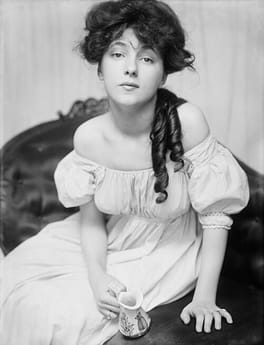
Photo: Gertrude Käsebier / Public domain (source: Wikimedia Commons)
Evelyn Nesbit was born in Tarentum, Pennsylvania, United States on December 25, 1884. Evelyn Nesbit was credited as a stage actor, film actor and dancer. Death is recorded on January 17, 1967, at the age of 82.
My Take
Evelyn Nesbit is one of those figures from history who feels almost too dramatic to be real, yet every bit of her story checks out. Born into poverty in Pennsylvania, she became the face of Gilded Age New York — a teenage model whose image was everywhere, from magazine covers to souvenir postcards, decades before anyone coined the word "supermodel." She moved effortlessly between modeling, Broadway chorus lines, and silent film, which was genuinely rare for the era. But what cemented her in the history books was the 1906 murder of architect Stanford White by her unstable husband Harry Thaw — the so-called "Trial of the Century" — where Evelyn was both victim and unwilling centerpiece. What strikes me is how she kept going long after that circus ended, living all the way to 1967, a quiet survivor of a story that would have broken almost anyone else.
This take was written by generative AI, one per person, from publicly reported facts (editorial policy). It is a reading of the record, not reporting.
1. Profile
- Name (English)
- Evelyn Nesbit
- Name (Japanese)
- イヴリン・ネズビット
- Reading
- いゔりん・ねずびっと
- Born
- December 25, 1884 – January 17, 1967
- Origin
- Tarentum, Pennsylvania, United States
- Occupation
- model / stage actor / film actor / dancer / fashion model
- Zodiac / Chinese zodiac
- Capricorn / Monkey
2. Links
3. About this entry
Tags
- Last updated
Only publicly available facts are listed; non-public or unconfirmed items are omitted. Base data was compiled from Wikidata from June 2026 onward; ages are recalculated daily and deaths are checked against Wikidata on an ongoing basis. English text is machine-assisted (facts translated by Sonnet, "My Take" written by Opus 4.8). The Japanese page is the source of record.
Frequently asked questions
When was Evelyn Nesbit born?
Evelyn Nesbit was born on December 25, 1884.
When did Evelyn Nesbit die?
Evelyn Nesbit died on January 17, 1967, aged 82.
Where was Evelyn Nesbit from?
Evelyn Nesbit was from Tarentum, Pennsylvania, United States.
What did Evelyn Nesbit do?
Evelyn Nesbit worked as model, stage actor, film actor, dancer, fashion model.
Model — see all → · Stage actor — see all → · More people from the United States → · More people born on December 25 →