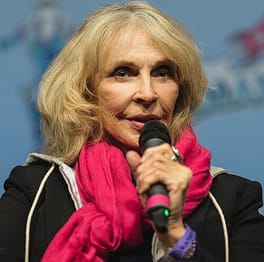
Photo: John Manard / CC BY-SA 4.0 (source: Wikimedia Commons)
Gates McFadden is a television actor, film actor and choreographer. Gates McFadden was born in Akron, Ohio, United States on March 2, 1949. That works out to 77 years old in 2026. Schooling on record includes Brandeis University.
My Take
Gates McFadden will always be Dr. Beverly Crusher to me, and that's a compliment to how fully she inhabited the role across The Next Generation, four films, Picard, and Prodigy. What I didn't fully appreciate until reading about her is the dual career: she's credited as Cheryl McFadden when she works as a choreographer, a discipline she trained in seriously after Brandeis. That blend of movement expertise and acting gives her performances a physical thoughtfulness. There's something admirable about an Ohio-born artist who refused to be only one thing, quietly building a body of work behind the camera as well as in front of it.
This take was written by generative AI, one per person, from publicly reported facts (editorial policy). It is a reading of the record, not reporting.
1. Profile
- Name (English)
- Gates McFadden
- Name (Japanese)
- ゲイツ・マクファーデン
- Reading
- げいつ・まくふぁーでん
- Born
- March 2, 1949 (age 77)
- Origin
- Akron, Ohio, United States
- Occupation
- television actor / film actor / actor / choreographer / camera operator
- Zodiac / Chinese zodiac
- Pisces / Ox
2. Background
- University
- Brandeis University
3. Links
4. About this entry
Tags
- Last updated
Facts are limited to publicly available information up to 2024; non-public or unconfirmed items are omitted. English text is machine-assisted (facts translated by Sonnet, "My Take" written by Opus 4.8). The Japanese page is the source of record.
Frequently asked questions
When was Gates McFadden born?
Born March 2, 1949 (age 77).
Where is Gates McFadden from?
Gates McFadden is from Akron, Ohio, United States.
What does Gates McFadden do?
Gates McFadden works as television actor, film actor, actor, choreographer, camera operator.
Television actor — see all → · Film actor — see all → · More people from the United States →