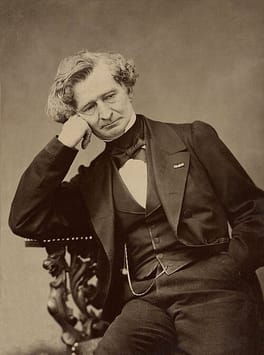
Photo: Pierre Petit / Public domain (source: Wikimedia Commons)
Hector Berlioz was born on December 11, 1803 in La Côte-Saint-André, France and was credited as a conductor, writer and autobiographer. Death is recorded on March 8, 1869, at the age of 65. Awards on record include Prix de Rome, Officer of the Legion of Honour (1864) and Knight of the Legion of Honour (1839). Hector Berlioz was associated with Requiem, Roméo et Juliette and Symphonie fantastique.
My Take
Berlioz is one of those composers who felt genuinely too big for his era, and honestly, I think that's what made him so endlessly fascinating. The Symphonie fantastique alone — written when he was just 26, basically a fever dream about obsessive love set to an orchestra he was reinventing in real time — is one of the most audacious debut statements in all of Western music. He couldn't play piano well, he had almost no formal harmony training, yet he wrote for orchestras like nobody before him had dared, conjuring textures and colors that conductors are still unpacking today. His Requiem calls for four brass bands positioned at the four corners of the hall — the man was theatrical to his bones. France never quite knew what to do with him during his lifetime, and that restlessness comes through in everything he wrote. A genuine original.
This take was written by generative AI, one per person, from publicly reported facts (editorial policy). It is a reading of the record, not reporting.
1. Profile
- Name (English)
- Hector Berlioz
- Name (Japanese)
- エクトル・ベルリオーズ
- Reading
- えくとる・べるりおーず
- Born
- December 11, 1803 – March 8, 1869
- Origin
- La Côte-Saint-André, France
- Occupation
- conductor / writer / autobiographer / music critic / librettist
- Zodiac / Chinese zodiac
- Sagittarius / Boar
2. Background
Awards & achievements
- Prix de Rome
- 1864 Officer of the Legion of Honour
- 1839 Knight of the Legion of Honour
3. Works & records
Filmography / notable works
| Category | Title |
|---|---|
| Notable work | Requiem |
| Notable work | Roméo et Juliette |
| Notable work | Symphonie fantastique |
| Notable work | La damnation de Faust |
| Notable work | Les Troyens |
| Notable work | Le carnaval romain |
4. Links
- Official sitehttp://www.hberlioz.com
- Wikipedia (English)https://en.wikipedia.org/wiki/Hector%20Berlioz
- Wikipedia (Japanese)https://ja.wikipedia.org/wiki/%E3%82%A8%E3%82%AF%E3%83%88%E3%83%AB%E3%83%BB%E3%83%99%E3%83%AB%E3%83%AA%E3%82%AA%E3%83%BC%E3%82%BA
- Wikidatahttps://www.wikidata.org/wiki/Q1151
5. About this entry
Tags
- Last updated
Only publicly available facts are listed; non-public or unconfirmed items are omitted. Base data was compiled from Wikidata from June 2026 onward; ages are recalculated daily and deaths are checked against Wikidata on an ongoing basis. English text is machine-assisted (facts translated by Sonnet, "My Take" written by Opus 4.8). The Japanese page is the source of record.
Frequently asked questions
When was Hector Berlioz born?
Hector Berlioz was born on December 11, 1803.
When did Hector Berlioz die?
Hector Berlioz died on March 8, 1869, aged 65.
Where was Hector Berlioz from?
Hector Berlioz was from La Côte-Saint-André, France.
What did Hector Berlioz do?
Hector Berlioz worked as conductor, writer, autobiographer, music critic, librettist.
What was Hector Berlioz known for?
Hector Berlioz's notable works include Requiem, Roméo et Juliette, Symphonie fantastique.
Conductor — see all → · Writer — see all → · More people from France → · More people born on December 11 →