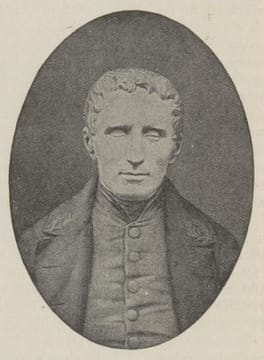
Photo: Unknown author / Public domain (source: Wikimedia Commons)
Louis Braille was born in Coupvray, Seine-et-Marne, France on January 4, 1809. Public records list Louis Braille as an organist, inventor and educator of the blind. Death is recorded on January 6, 1852, at the age of 43.
My Take
Honestly, Louis Braille might be the most quietly world-changing person in this entire database. He lost his sight as a toddler after an accident in his father's workshop, was sent to the Royal Institution for Blind Youth in Paris, and by his mid-teens had already devised a tactile reading system that would outlive every piece of technology invented in his lifetime — and most invented since. What gets me is the elegance of it: six dots, sixty-three possible combinations, and suddenly the written word belongs to everyone. He was also a gifted organist and a dedicated teacher, not some lone genius holed up in isolation. He died at just 42, and France didn't even formally adopt his system until two years after he was gone. History corrected that oversight, though — today braille is used in virtually every language on earth, and his name is literally read by fingertip every single day.
This take was written by generative AI, one per person, from publicly reported facts (editorial policy). It is a reading of the record, not reporting.
1. Profile
- Name (English)
- Louis Braille
- Name (Japanese)
- ルイ・ブライユ
- Reading
- るい・ぶらいゆ
- Born
- January 4, 1809 – January 6, 1852
- Origin
- Coupvray, Seine-et-Marne, France
- Occupation
- organist / inventor / educator of the blind
- Zodiac / Chinese zodiac
- Capricorn / Snake
2. Links
- Wikipedia (English)https://en.wikipedia.org/wiki/Louis%20Braille
- Wikipedia (Japanese)https://ja.wikipedia.org/wiki/%E3%83%AB%E3%82%A4%E3%83%BB%E3%83%96%E3%83%A9%E3%82%A4%E3%83%A6
- Wikidatahttps://www.wikidata.org/wiki/Q93182
3. About this entry
Tags
- Last updated
Facts are limited to publicly available information up to 2024; non-public or unconfirmed items are omitted. English text is machine-assisted (facts translated by Sonnet, "My Take" written by Opus 4.8). The Japanese page is the source of record.
Frequently asked questions
When was Louis Braille born?
Born January 4, 1809.
When did Louis Braille die?
Died January 6, 1852, aged 43.
Where was Louis Braille from?
Louis Braille was from Coupvray, Seine-et-Marne, France.
What did Louis Braille do?
Louis Braille worked as organist, inventor, educator of the blind.
Organist — see all → · Inventor — see all → · More people from France →