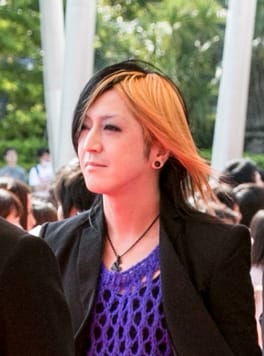
Photo: Norio NAKAYAMA / CC BY-SA 2.0 (source: Wikimedia Commons)
My Take
I've always had a soft spot for HISASHI, because there's something so right about a guitarist from snowy Hirosaki up in Aomori ending up as the wild, melodic backbone of GLAY. He's the guy who makes those big, anthemic rock songs bite, all swirling tone and effects-pedal mischief, and yet offstage he reads like the friendliest gadget nerd alive, geeking out online about gear, robots, and whatever weird toy caught his eye that week. I love that contrast: a player who can be genuinely loud and inventive on a record but keeps a low-key, tinkerer's grin in real life. He's never struck me as the self-promoting type; he just shows up, plays with real craft and personality, and lets the riffs do the bragging. Quietly one of my favorite Japanese rock guitarists, honestly.
This take was written by generative AI, one per person, from publicly reported facts (editorial policy). It is a reading of the record, not reporting.
Overview
HISASHI is a Japanese guitarist born on February 2, 1972, in Hirosaki, Aomori Prefecture. He attended Hokkaido Hakodate Ryohoku High School. He is active on Instagram and X (Twitter), where he shares content related to his interests and work. He is best known as the lead guitarist of the rock band GLAY.
1. Profile
- Name (English)
- HISASHI
- Name (Japanese)
- HISASHI
- Reading
- ひさし
- Born
- February 2, 1972 (age 54)
- Origin
- Hirosaki, Aomori Prefecture, Japan
- Occupation
- Guitarist
- Zodiac / Chinese zodiac
- Aquarius / Rat
- Active years
- 1987 -
2. Background
- High school
- Hokkaido Hakodate Ryohoku High School
3. Works & records
Works summary
- Works
- 45 (1996–2025)
- By year
- 1996: 2, 1997: 1, 1998: 1, 1999: 1, 2002: 1, 2005: 1, 2006: 1, 2008: 2, 2009: 1, 2010: 2, 2013: 1, 2014: 4, 2015: 4, 2016: 3, 2017: 2, 2018: 3, 2020: 2, 2021: 1, 2022: 2, 2023: 1, 2024: 6, 2025: 3
Filmography / notable works
| Category | Title | Year |
|---|---|---|
| Media appearance | Pokapoka | 2025 |
| Media appearance | ガリベンガーV | 2025 |
| Media appearance | Can I Follow You Home? | 2025 |
| Media appearance | Pre-batt!! | 2024 |
| Media appearance | 4月1日はよいの日 3時間SP 吉田類の酒場放浪記+町中華で飲ろうぜ | 2024 |
| Media appearance | Kaiun! Nandemo kanteidan | 2024 |
| Media appearance | ¥ジョイグルメウォークin横浜中華街 | 2024 |
| Media appearance | STUDIO HISASHI with Anime | 2024 |
| Media appearance | 第3回大パチンコ大会!拡大SP!芸人×アーティスト×モデルの三巴!! | 2024 |
| Media appearance | DOWN TOWN DX | 2023 |
| Media appearance | 人志松本の酒のツマミになる話 | 2022 |
| Media appearance | THE Karaoke★Battle | 2022 |
| Media appearance | RX-72 〜HISASHI | 2009 |
| Media appearance | HISASHI'S CYBER NET CITY FULL METAL MIX | 2008 |
4. Links
- Instagramhttps://www.instagram.com/hisashix/
- Xhttps://x.com/HISASHI_
- Wikipedia (Japanese)https://ja.wikipedia.org/wiki/HISASHI
- Wikidatahttps://www.wikidata.org/wiki/Q390203
5. About this entry
Tags
- Last updated
Only publicly available facts are listed; non-public or unconfirmed items are omitted. Base data was compiled from Wikidata from June 2026 onward; ages are recalculated daily and deaths are checked against Wikidata on an ongoing basis. Works and profile fields sourced from Wikipedia reflect content as of 2026-08-26. English text is machine-assisted (facts translated by Sonnet, "My Take" written by Opus 4.8). The Japanese page is the source of record.
Frequently asked questions
When was HISASHI born?
HISASHI was born on February 2, 1972 and is 54 years old.
Where is HISASHI from?
HISASHI is from Hirosaki, Aomori Prefecture, Japan.
What does HISASHI do?
HISASHI works as Guitarist.
Which high school did HISASHI attend?
HISASHI attended Hokkaido Hakodate Ryohoku High School.
How long has HISASHI been active?
HISASHI has been active since 1987.
What is HISASHI known for?
HISASHI's notable works include STUDIO HISASHI with Anime, RX-72 〜HISASHI, HISASHI'S CYBER NET CITY FULL METAL MIX.
Guitarist — see all → · More people from Japan → · More people born on February 2 →