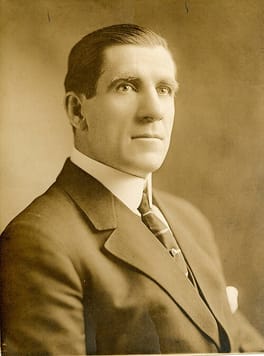
Photo: Unknown author / Public domain (source: Wikimedia Commons)
James John Corbett, born on September 1, 1866 in San Francisco, California, United States, was a boxer, film actor and stage actor. James John Corbett died on February 18, 1933, aged 66. Recorded honors include International Boxing Hall of Fame (1990). The listed height was 185 cm.
My Take
James J. Corbett fascinates me because he dragged boxing into the modern age almost single-handedly. Standing 185 cm and fighting with footwork and strategy rather than brute force, he beat the seemingly invincible John L. Sullivan and rewrote what a champion could be. I see him as the sport's first true technician, the man who proved intelligence belonged in the ring. His later turn to the stage and screen shows a showman who understood spectacle long before anyone called it that. Inducted into the Hall of Fame in 1990, he remains, to me, the elegant bridge between bare-knuckle brawling and the science of boxing.
This take was written by generative AI, one per person, from publicly reported facts (editorial policy). It is a reading of the record, not reporting.
1. Profile
- Name (English)
- James John Corbett
- Name (Japanese)
- ジェームス・J・コーベット
- Reading
- じぇーむす・J・こーべっと
- Born
- September 1, 1866 – February 18, 1933
- Origin
- San Francisco, California, United States
- Height
- 185 cm
- Occupation
- boxer / actor / film actor / stage actor / screenwriter
- Zodiac / Chinese zodiac
- Virgo / Tiger
2. Background
Awards & achievements
- 1990 International Boxing Hall of Fame
3. Links
4. About this entry
Tags
- Last updated
Facts are limited to publicly available information up to 2024; non-public or unconfirmed items are omitted. English text is machine-assisted (facts translated by Sonnet, "My Take" written by Opus 4.8). The Japanese page is the source of record.
Frequently asked questions
When was James John Corbett born?
James John Corbett was born on September 1, 1866.
When did James John Corbett die?
James John Corbett died on February 18, 1933, aged 66.
Where was James John Corbett from?
James John Corbett was from San Francisco, California, United States.
What did James John Corbett do?
James John Corbett worked as boxer, actor, film actor, stage actor, screenwriter.
How tall was James John Corbett?
James John Corbett was 185 cm tall.
Boxer — see all → · Actor — see all → · More people from the United States → · More people born on September 1 →