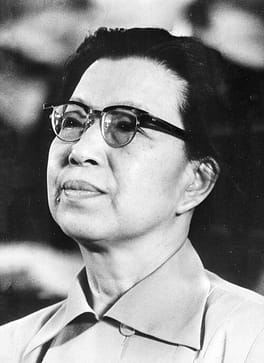
Photo: Unknown author / CC BY-SA 3.0 nl (source: Wikimedia Commons)
Public records list Jiang Qing as a politician and film actor. Jiang Qing was born on March 5, 1914 in Zhucheng, People's Republic of China. Death is recorded on May 14, 1991, at the age of 77. Education on record includes Military and Political University of Resistance Against Japan. Awards on record include Royal Order of Cambodia (1964).
My Take
Few twentieth-century lives swing as violently as Jiang Qing's. What fascinates me is the arc itself: a Shandong-born woman who acted under the name Lan Ping in 1930s Shanghai, only to end up at the absolute center of the Cultural Revolution as the wife of Mao Zedong and leader of the Gang of Four. After Mao's death she was arrested, sentenced to death with a reprieve in a televised trial, had the sentence commuted to life imprisonment, and hanged herself in 1991. But I keep returning to the idea of an aspiring actress finding herself cast in the bloodiest political drama of her age, and wondering what she believed she was doing. That gap between the dream and the reality is haunting.
This take was written by generative AI, one per person, from publicly reported facts (editorial policy). It is a reading of the record, not reporting.
1. Profile
- Name (English)
- Jiang Qing
- Name (Japanese)
- 江青
- Reading
- こう せい
- Born
- March 5, 1914 – May 14, 1991
- Origin
- Zhucheng, People's Republic of China
- Occupation
- actor / politician / film actor
- Zodiac / Chinese zodiac
- Pisces / Tiger
2. Background
- University
- Military and Political University of Resistance Against Japan
Awards & achievements
- 1964 Royal Order of Cambodia
3. Links
- Wikipedia (English)https://en.wikipedia.org/wiki/Jiang%20Qing
- Wikipedia (Japanese)https://ja.wikipedia.org/wiki/%E6%B1%9F%E9%9D%92
- Wikidatahttps://www.wikidata.org/wiki/Q236017
4. About this entry
Tags
- Last updated
Facts are limited to publicly available information up to 2024; non-public or unconfirmed items are omitted. English text is machine-assisted (facts translated by Sonnet, "My Take" written by Opus 4.8). The Japanese page is the source of record.
Frequently asked questions
When was Jiang Qing born?
Jiang Qing was born on March 5, 1914.
When did Jiang Qing die?
Jiang Qing died on May 14, 1991, aged 77.
Where was Jiang Qing from?
Jiang Qing was from Zhucheng, People's Republic of China.
What did Jiang Qing do?
Jiang Qing worked as actor, politician, film actor.
Where did Jiang Qing study?
Jiang Qing attended Military and Political University of Resistance Against Japan.
Actor — see all → · Politician — see all → · More people from the People's Republic of China → · More people born on March 5 →