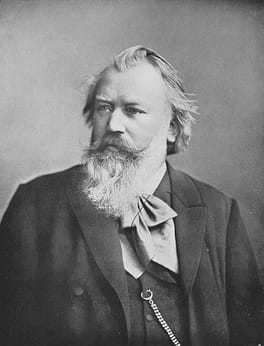
Photo: C. Brasch, Berlin (biography) / Public domain (source: Wikimedia Commons)
Johannes Brahms was listed as a composer, conductor and pianist. Johannes Brahms was born in Hamburg, United States on May 7, 1833. Death is recorded on April 3, 1897, at the age of 63. Awards on record include Pour le Mérite for Sciences and Arts order (1886), Bavarian Maximilian Order for Science and Art (1874), Royal Philharmonic Society Gold Medal (1877) and 5 more. Credited works include Symphony No. 4, Symphony No. 1 and Academic Festival Overture.
My Take
Brahms is one of those composers who just gets better the more you listen to him — and I say that as someone who came to him late. Born in Hamburg in 1833, he spent decades wrestling with Beethoven's shadow before finally releasing his First Symphony when he was already in his forties, and honestly, the wait was worth every year. The man never rushed anything, and you can feel that patience baked into every bar — that warmth beneath the counterpoint, the rhythms that push and pull like a conversation between old friends. A German Requiem still floors me every time. He never married, lived simply, walked everywhere around Vienna, and let his music do all the talking. Died in 1897, not long after Clara Schumann, the great love of his life, which feels like the universe had a sense of narrative. A true original who looked backward and forward at once.
This take was written by generative AI, one per person, from publicly reported facts (editorial policy). It is a reading of the record, not reporting.
1. Profile
- Name (English)
- Johannes Brahms
- Name (Japanese)
- ヨハネス・ブラームス
- Reading
- よはねす・ぶらーむす
- Born
- May 7, 1833 – April 3, 1897
- Origin
- Hamburg, United States
- Occupation
- composer / conductor / pianist
- Zodiac / Chinese zodiac
- Taurus / Snake
2. Background
Awards & achievements
- 1886 Pour le Mérite for Sciences and Arts order
- 1874 Bavarian Maximilian Order for Science and Art
- 1877 Royal Philharmonic Society Gold Medal
- 1879 honorary doctor of the University of Wrocław
- 1877 honorary doctorate from the University of Cambridge
- 1889 honorary citizen of Hamburg
- 1893 Order of Leopold
- Austrian Decoration for Science and Art
3. Works & records
Filmography / notable works
| Category | Title |
|---|---|
| Notable work | Symphony No. 4 |
| Notable work | Symphony No. 1 |
| Notable work | Academic Festival Overture |
| Notable work | Tragic Overture |
| Notable work | A German Requiem |
| Notable work | Symphony No. 3 |
4. Links
- Official sitehttps://www.brahms-institut.de/index.php/de/allgemeines
- Wikipedia (English)https://en.wikipedia.org/wiki/Johannes%20Brahms
- Wikipedia (Japanese)https://ja.wikipedia.org/wiki/%E3%83%A8%E3%83%8F%E3%83%8D%E3%82%B9%E3%83%BB%E3%83%96%E3%83%A9%E3%83%BC%E3%83%A0%E3%82%B9
- Wikidatahttps://www.wikidata.org/wiki/Q7294
5. About this entry
Tags
- Last updated
Facts are limited to publicly available information up to 2024; non-public or unconfirmed items are omitted. English text is machine-assisted (facts translated by Sonnet, "My Take" written by Opus 4.8). The Japanese page is the source of record.
Frequently asked questions
When was Johannes Brahms born?
Born May 7, 1833.
When did Johannes Brahms die?
Died April 3, 1897, aged 63.
Where was Johannes Brahms from?
Johannes Brahms was from Hamburg, United States.
What did Johannes Brahms do?
Johannes Brahms worked as composer, conductor, pianist.
What was Johannes Brahms known for?
Notable works include Symphony No. 4, Symphony No. 1, Academic Festival Overture.
Composer — see all → · Conductor — see all → · More people from the United States →