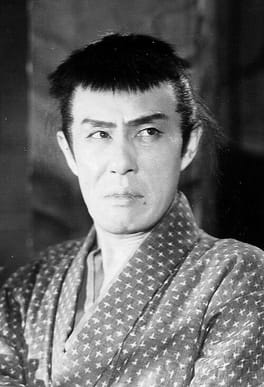
Photo: Daiei / Public domain (source: Wikimedia Commons)
My Take
I'll be honest, Kanjūrō Arashi is a name a lot of younger folks won't recognize, but for me he's basically the face of old-school jidaigeki, the kind of swordplay star whose mere stance carries the whole frame. Born in Kyoto in 1902 and crossing over from the stage world into early Japanese cinema, he brought this trained, grounded physicality to every move, so even just standing there gripping a blade he gives the shot a spine. What I love is that he didn't just act, he produced his own pictures too, which tells me he was one of those restless souls who genuinely wanted to make something good rather than coast. He worked right through the silent era and into sound, and that rugged, weathered period-drama gravitas of his is a flavor I honestly don't think modern actors can fake. A real craftsman.
This take was written by generative AI, one per person, from publicly reported facts (editorial policy). It is a reading of the record, not reporting.
Overview
Kanjūrō Arashi (1902–1980) was a Japanese actor, kabuki performer, and film producer born in Kiyamachi-dori, Kyoto. Rooted in the kabuki tradition, he transitioned into the film world and became a prominent figure in Japanese period dramas from his film debut in 1927 through the Showa era. Beyond performing, he took on the role of film producer, demonstrating a broader ambition to shape the stories he brought to screen. He passed away on October 21, 1980.
1. Profile
- Name (English)
- Kanjūrō Arashi
- Name (Japanese)
- 嵐寛寿郎
- Reading
- あらし かんじゅうろう
- Born
- December 8, 1902 – October 21, 1980
- Origin
- Kyoto, Japan
- Occupation
- Actor / Film Producer / Kabuki Actor / Film Actor
- Zodiac / Chinese zodiac
- Sagittarius / Tiger
- Active years
- 1919 - 1980
2. Links
- Wikipedia (Japanese)https://ja.wikipedia.org/wiki/%E5%B5%90%E5%AF%9B%E5%AF%BF%E9%83%8E
- Wikidatahttps://www.wikidata.org/wiki/Q3192687
3. About this entry
Tags
- Last updated
Only publicly available facts are listed; non-public or unconfirmed items are omitted. Base data was compiled from Wikidata from June 2026 onward; ages are recalculated daily and deaths are checked against Wikidata on an ongoing basis. Works and profile fields sourced from Wikipedia reflect content as of 2026-08-26. English text is machine-assisted (facts translated by Sonnet, "My Take" written by Opus 4.8). The Japanese page is the source of record.
Frequently asked questions
When was Kanjūrō Arashi born?
Kanjūrō Arashi was born on December 8, 1902.
When did Kanjūrō Arashi die?
Kanjūrō Arashi died on October 21, 1980, aged 77.
Where was Kanjūrō Arashi from?
Kanjūrō Arashi was from Kyoto, Japan.
What did Kanjūrō Arashi do?
Kanjūrō Arashi worked as Actor, Film Producer, Kabuki Actor, Film Actor.
When was Kanjūrō Arashi active?
Kanjūrō Arashi was active from 1919 to 1980.
Actor — see all → · Film Producer — see all → · More people from Japan → · More people born on December 8 →