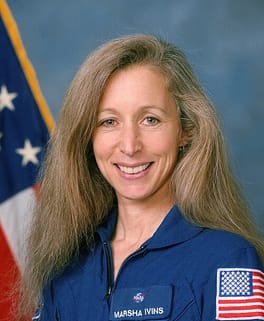
Photo: No information / Public domain (source: Wikimedia Commons)
Marsha Ivins was born on April 15, 1951 in Baltimore, Maryland, United States and is credited as an astronaut and engineer. That puts Marsha Ivins at 75 years old in 2026. Schooling on record includes Nether Providence High School and University of Colorado. Awards on record include NASA Exceptional Service Medal (1988, 1993, 1995), NASA Space Flight Medal (1990, 1992, 1994, 1997) and NASA Exceptional Achievement Medal (2006).
My Take
Marsha Ivins is the kind of person I find genuinely awe-inspiring. A Colorado-trained engineer from Baltimore who flew five Space Shuttle missions, with a row of NASA medals to mark the work, she reached space the hard way, through technical mastery rather than spectacle. Born in 1951, she pushed into spaceflight when the path for women was steeper than most can imagine. What I admire most is that her heroism is unflashy: she is the engineer who understands every bolt and then rides the machine into orbit. That blend of competence and courage is exactly the sort of real expertise I quietly idolize.
This take was written by generative AI, one per person, from publicly reported facts (editorial policy). It is a reading of the record, not reporting.
1. Profile
- Name (English)
- Marsha Ivins
- Name (Japanese)
- マーシャ・アイビンス
- Reading
- まーしゃ・あいびんす
- Born
- April 15, 1951 (age 75)
- Origin
- Baltimore, Maryland, United States
- Occupation
- astronaut / engineer
- Zodiac / Chinese zodiac
- Aries / Rabbit
2. Background
- High school
- Nether Providence High School
- University
- University of Colorado
Awards & achievements
- 1988 NASA Exceptional Service Medal
- 1990 NASA Space Flight Medal
- 1992 NASA Space Flight Medal
- 1993 NASA Exceptional Service Medal
- 1994 NASA Space Flight Medal
- 1995 NASA Exceptional Service Medal
- 1997 NASA Space Flight Medal
- 2006 NASA Exceptional Achievement Medal
3. Links
4. About this entry
Tags
- Last updated
Facts are limited to publicly available information up to 2024; non-public or unconfirmed items are omitted. English text is machine-assisted (facts translated by Sonnet, "My Take" written by Opus 4.8). The Japanese page is the source of record.
Frequently asked questions
When was Marsha Ivins born?
Born April 15, 1951 (age 75).
Where is Marsha Ivins from?
Marsha Ivins is from Baltimore, Maryland, United States.
What does Marsha Ivins do?
Marsha Ivins works as astronaut, engineer.
Astronaut — see all → · Engineer — see all → · More people from the United States →