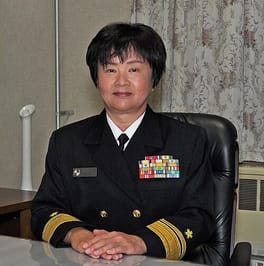
Photo: https://www.mod.go.jp/msdf/index.html 海上自衛隊 / CC BY 4.0 (source: Wikimedia Commons)
My Take
Natsue Kondo is the kind of person whose career reads like a quiet, relentless dismantling of every ceiling put in front of her. She joined Japan's Maritime Self-Defense Force in 1989 at a time when women couldn't even be assigned to ships, spent decades in logistics and supply roles — the unglamorous backbone work — and just kept climbing. First female flag officer, first female regional commander, and then in December 2023, the first woman ever to reach Vice Admiral in the JMSDF. That's 34 years of showing up in an institution that wasn't built for you and eventually making it yours. No splashy press moments, no viral story — just rank after rank falling. Born in Iwakuni, Yamaguchi, trained at a local national university, became one of the most quietly consequential figures in modern Japanese military history. I find that genuinely impressive in a way that flashier careers rarely are.
This take was written by generative AI, one per person, from publicly reported facts (editorial policy). It is a reading of the record, not reporting.
Overview
Natsue Kondo (born January 13, 1966) is a retired Japanese naval officer from Iwakuni, Yamaguchi Prefecture. She graduated from Yamaguchi University, joined the Maritime Self-Defense Force in 1989, and in December 2023 became its first female vice admiral and commandant of the Ōminato District; she retired in August 2025.
1. Profile
- Name (English)
- Natsue Kondo
- Name (Japanese)
- 近藤奈津枝
- Reading
- こんどう なつえ
- Born
- January 13, 1966 (age 60)
- Origin
- Yamaguchi Prefecture, Japan
- Occupation
- Naval officer
- Zodiac / Chinese zodiac
- Capricorn / Horse
2. Background
- University
- Yamaguchi University
3. Links
4. About this entry
Tags
- Last updated
Only publicly available facts are listed; non-public or unconfirmed items are omitted. Base data was compiled from Wikidata from June 2026 onward; ages are recalculated daily and deaths are checked against Wikidata on an ongoing basis. English text is machine-assisted (facts translated by Sonnet, "My Take" written by Opus 4.8). The Japanese page is the source of record.
Frequently asked questions
When was Natsue Kondo born?
Natsue Kondo was born on January 13, 1966 and is 60 years old.
Where is Natsue Kondo from?
Natsue Kondo is from Yamaguchi Prefecture, Japan.
What does Natsue Kondo do?
Natsue Kondo works as Naval officer.
Where did Natsue Kondo study?
Natsue Kondo attended Yamaguchi University.
Naval officer — see all → · More people from Japan → · More people born on January 13 →