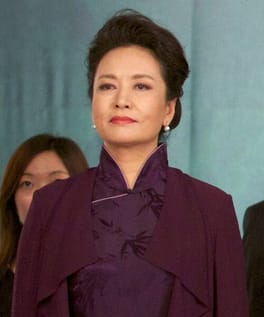
Photo: Angélica Rivera de Peña / CC BY-SA 2.0 (source: Wikimedia Commons)
Peng Liyuan was born on November 20, 1962 in Yuncheng County, People's Republic of China. Peng Liyuan is credited as a performing artist, university teacher and military personnel. The age as of 2026 is 63. Awards on record include honorary doctor of Massey University (2014).
My Take
Peng Liyuan is one of those rare figures who was already a bona fide celebrity in her own right long before the world really took notice of her. She was a household name in China throughout the 1980s and 90s as a folk singer with the People's Liberation Army, the kind of performer who packed national television broadcasts and earned genuine popular affection — not because of who she married, but because of her voice. The fact that her husband turned out to be Xi Jinping, who rose to become China's paramount leader in 2012, then cast her into the global spotlight as First Lady, always felt like a secondary chapter in a story that had already been going for decades. I find it genuinely interesting that she holds a doctorate-level credential and an honorary doctorate from Massey University (2014), because she comes across as someone who took the craft seriously. She's a rare breed: a real artist who ended up in the most politically fraught role imaginable.
This take was written by generative AI, one per person, from publicly reported facts (editorial policy). It is a reading of the record, not reporting.
1. Profile
- Name (English)
- Peng Liyuan
- Name (Japanese)
- 彭麗媛
- Reading
- ほう・れいえん
- Born
- November 20, 1962 (age 63)
- Origin
- Yuncheng County, People's Republic of China
- Occupation
- performing artist / university teacher / military personnel / politician / actor
- Zodiac / Chinese zodiac
- Scorpio / Tiger
2. Background
Awards & achievements
- 2014 honorary doctor of Massey University
3. Links
- Wikipedia (English)https://en.wikipedia.org/wiki/Peng%20Liyuan
- Wikipedia (Japanese)https://ja.wikipedia.org/wiki/%E5%BD%AD%E9%BA%97%E5%AA%9B
- Wikidatahttps://www.wikidata.org/wiki/Q430911
4. About this entry
Tags
- Last updated
Facts are limited to publicly available information up to 2024; non-public or unconfirmed items are omitted. English text is machine-assisted (facts translated by Sonnet, "My Take" written by Opus 4.8). The Japanese page is the source of record.
Frequently asked questions
When was Peng Liyuan born?
Born November 20, 1962 (age 63).
Where is Peng Liyuan from?
Peng Liyuan is from Yuncheng County, People's Republic of China.
What does Peng Liyuan do?
Peng Liyuan works as performing artist, university teacher, military personnel, politician, actor.
Performing artist — see all → · University teacher — see all → · More people from the People's Republic of China →