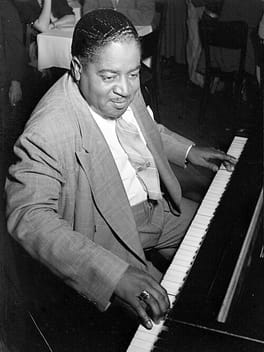
Photo: William P. Gottlieb / Public domain (source: Wikimedia Commons)
Pete Johnson was listed as a pianist, jazz musician and songwriter. Born on March 25, 1904, Pete Johnson was from Kansas City, Missouri, United States. Death is recorded on March 23, 1967, at the age of 62.
My Take
Pete Johnson makes my foot tap before I can think. Born in Kansas City in 1904, he was a master of boogie-woogie, and that rolling, locomotive left hand still electrifies me every time. As part of the Boogie Woogie Trio he paired technical virtuosity with real melodic richness, yet he rarely gets the headline space he deserves in jazz history. To me, anyone who could make a piano dance that hard belongs higher in the canon. He died in 1967, but the joy in his keyboard work hasn't aged a day. This is the kind of earthy, unpretentious musician I love most, and I'm simply grateful the recordings survive.
This take was written by generative AI, one per person, from publicly reported facts (editorial policy). It is a reading of the record, not reporting.
1. Profile
- Name (English)
- Pete Johnson
- Name (Japanese)
- ピート・ジョンソン
- Reading
- ぴーと・じょんそん
- Born
- March 25, 1904 – March 23, 1967
- Origin
- Kansas City, Missouri, United States
- Occupation
- pianist / jazz musician / songwriter / recording artist / musician
- Zodiac / Chinese zodiac
- Aries / Dragon
2. Links
3. About this entry
Tags
- Last updated
Facts are limited to publicly available information up to 2024; non-public or unconfirmed items are omitted. English text is machine-assisted (facts translated by Sonnet, "My Take" written by Opus 4.8). The Japanese page is the source of record.
Frequently asked questions
When was Pete Johnson born?
Born March 25, 1904.
When did Pete Johnson die?
Died March 23, 1967, aged 62.
Where was Pete Johnson from?
Pete Johnson was from Kansas City, Missouri, United States.
What did Pete Johnson do?
Pete Johnson worked as pianist, jazz musician, songwriter, recording artist, musician.
Pianist — see all → · Jazz musician — see all → · More people from the United States →