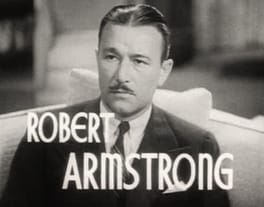
Photo: Trailer screenshot / Public domain (source: Wikimedia Commons)
Robert Armstrong was listed as a film actor. Robert Armstrong was born on November 20, 1890 in Saginaw, Michigan, United States. Death is recorded on April 20, 1973, at the age of 82. Education on record includes University of Washington School of Law.
My Take
Robert Armstrong will forever be the man who delivered one of cinema's most famous closing lines in the 1933 King Kong. To me there is real charm in his backstory: a Michigan native who studied law at the University of Washington before choosing the screen over the courtroom. As the showman Carl Denham, he gave that landmark monster film its human anchor, the ambition and bravado that set the whole tragedy in motion. He died in 1973, but every time Kong climbs that tower, Armstrong's voice and presence are woven into the legend. I think he was a genuinely fine character actor.
This take was written by generative AI, one per person, from publicly reported facts (editorial policy). It is a reading of the record, not reporting.
1. Profile
- Name (English)
- Robert Armstrong
- Name (Japanese)
- ロバート・アームストロング
- Reading
- ろばーと・あーむすとろんぐ
- Born
- November 20, 1890 – April 20, 1973
- Origin
- Saginaw, Michigan, United States
- Occupation
- actor / film actor
- Zodiac / Chinese zodiac
- Scorpio / Tiger
2. Background
- University
- University of Washington School of Law
3. Links
- Wikipedia (English)https://en.wikipedia.org/wiki/Robert%20Armstrong%20(actor)
- Wikipedia (Japanese)https://ja.wikipedia.org/wiki/%E3%83%AD%E3%83%90%E3%83%BC%E3%83%88%E3%83%BB%E3%82%A2%E3%83%BC%E3%83%A0%E3%82%B9%E3%83%88%E3%83%AD%E3%83%B3%E3%82%B0%20(%E4%BF%B3%E5%84%AA)
- Wikidatahttps://www.wikidata.org/wiki/Q82360
4. About this entry
Tags
- Last updated
Facts are limited to publicly available information up to 2024; non-public or unconfirmed items are omitted. English text is machine-assisted (facts translated by Sonnet, "My Take" written by Opus 4.8). The Japanese page is the source of record.
Frequently asked questions
When was Robert Armstrong born?
Robert Armstrong was born on November 20, 1890.
When did Robert Armstrong die?
Robert Armstrong died on April 20, 1973, aged 82.
Where was Robert Armstrong from?
Robert Armstrong was from Saginaw, Michigan, United States.
What did Robert Armstrong do?
Robert Armstrong worked as actor, film actor.
Where did Robert Armstrong study?
Robert Armstrong attended University of Washington School of Law.
Actor — see all → · Film actor — see all → · More people from the United States → · More people born on November 20 →