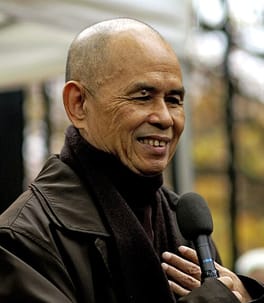
Photo: Duc (pixiduc) from Paris, France. / CC BY-SA 2.0 (source: Wikimedia Commons)
Thích Nhất Hạnh was born on October 11, 1926 in Huế, Vietnam and was credited as a Buddhist monk, poet and peace activist. Death is recorded on January 22, 2022, at the age of 95. Thích Nhất Hạnh studied at Princeton University. Listed accolades include honorary doctor of the University of Hong Kong.
My Take
Thích Nhất Hạnh belongs in a different category from most names I write about; he was less a public figure than a moral compass. A Vietnamese Zen monk who preached peace through the chaos of war, he became the wellspring of engaged Buddhism and founded the Plum Village tradition. What moves me is his gift for translation, taking profound teaching and distilling it into something as simple as paying attention to your own breath. He answered violence with stillness and tried to change the world through calm rather than rage. In that quiet I sense genuine, unshakable strength.
This take was written by generative AI, one per person, from publicly reported facts (editorial policy). It is a reading of the record, not reporting.
1. Profile
- Name (English)
- Thích Nhất Hạnh
- Name (Japanese)
- ティク・ナット・ハン
- Reading
- てぃく・なっと・はん
- Born
- October 11, 1926 – January 22, 2022
- Origin
- Huế, Vietnam
- Occupation
- Buddhist monk / poet / peace activist / writer / monk
- Zodiac / Chinese zodiac
- Libra / Tiger
2. Background
- University
- Princeton University
Awards & achievements
- honorary doctor of the University of Hong Kong
3. Links
- Official sitehttps://www.thich-nhat-hanh.fr/
- Xhttps://x.com/thichnhathanh
- Wikipedia (English)https://en.wikipedia.org/wiki/Th%C3%ADch%20Nh%E1%BA%A5t%20H%E1%BA%A1nh
- Wikipedia (Japanese)https://ja.wikipedia.org/wiki/%E3%83%86%E3%82%A3%E3%82%AF%E3%83%BB%E3%83%8A%E3%83%83%E3%83%88%E3%83%BB%E3%83%8F%E3%83%B3
- Wikidatahttps://www.wikidata.org/wiki/Q310913
4. About this entry
Tags
- Last updated
Facts are limited to publicly available information up to 2024; non-public or unconfirmed items are omitted. English text is machine-assisted (facts translated by Sonnet, "My Take" written by Opus 4.8). The Japanese page is the source of record.
Frequently asked questions
When was Thích Nhất Hạnh born?
Thích Nhất Hạnh was born on October 11, 1926.
When did Thích Nhất Hạnh die?
Thích Nhất Hạnh died on January 22, 2022, aged 95.
Where was Thích Nhất Hạnh from?
Thích Nhất Hạnh was from Huế, Vietnam.
What did Thích Nhất Hạnh do?
Thích Nhất Hạnh worked as Buddhist monk, poet, peace activist, writer, monk.
Where did Thích Nhất Hạnh study?
Thích Nhất Hạnh attended Princeton University.
Poet — see all → · More people from Vietnam → · More people born on October 11 →