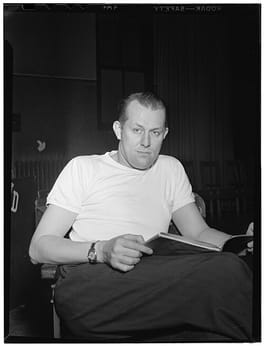
Photo: William P. Gottlieb / Public domain (source: Wikimedia Commons)
Vaughn Monroe, born on October 7, 1911 in Akron, Ohio, United States, was a bandleader, conductor and trumpeter. Vaughn Monroe died on May 21, 1973 at the age of 61. Education on record includes Carnegie Mellon University. Awards on record include star on Hollywood Walk of Fame.
My Take
Vaughn Monroe is the kind of name that instantly conjures a warmer, more elegant era. A baritone, trumpeter and bandleader who peaked in the 1940s and 1950s, he was a genuine triple threat who sang, played and conducted, and even stepped in front of film cameras. Two stars on the Hollywood Walk of Fame, one for recording and one for radio, say plenty about how thoroughly he owned his moment. What strikes me most is the richness of that low, velvet voice. Monroe passed in 1973, but I suspect his recordings still drift out of someone's speakers right now, and rightly so.
This take was written by generative AI, one per person, from publicly reported facts (editorial policy). It is a reading of the record, not reporting.
1. Profile
- Name (English)
- Vaughn Monroe
- Name (Japanese)
- ヴォーン・モンロー
- Reading
- ゔぉーん・もんろー
- Born
- October 7, 1911 – May 21, 1973
- Origin
- Akron, Ohio, United States
- Occupation
- bandleader / conductor / trumpeter / singer / film actor
- Zodiac / Chinese zodiac
- Libra / Boar
2. Background
- University
- Carnegie Mellon University
Awards & achievements
- star on Hollywood Walk of Fame
3. Links
- Official sitehttps://www.vaughnmonroesociety.org/
- Wikipedia (English)https://en.wikipedia.org/wiki/Vaughn%20Monroe
- Wikidatahttps://www.wikidata.org/wiki/Q528340
4. About this entry
Tags
- Last updated
Facts are limited to publicly available information up to 2024; non-public or unconfirmed items are omitted. English text is machine-assisted (facts translated by Sonnet, "My Take" written by Opus 4.8). The Japanese page is the source of record.
Frequently asked questions
When was Vaughn Monroe born?
Vaughn Monroe was born on October 7, 1911.
When did Vaughn Monroe die?
Vaughn Monroe died on May 21, 1973, aged 61.
Where was Vaughn Monroe from?
Vaughn Monroe was from Akron, Ohio, United States.
What did Vaughn Monroe do?
Vaughn Monroe worked as bandleader, conductor, trumpeter, singer, film actor.
Where did Vaughn Monroe study?
Vaughn Monroe attended Carnegie Mellon University.
Bandleader — see all → · Conductor — see all → · More people from the United States → · More people born on October 7 →