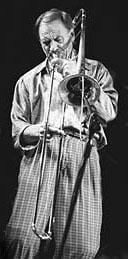
Photo: Unknown author / CC BY-SA 3.0 (source: Wikimedia Commons)
Albert Mangelsdorff was born on September 5, 1928 in Frankfurt, Darmstadt Government Region, Germany and was credited as a jazz musician, composer and trombonist. Albert Mangelsdorff died on July 25, 2005, aged 76. Recorded honors include Commander's Cross of the Order of Merit of the Federal Republic of Germany, Hessian Order of Merit (1998), Paul Acket Award and 3 more.
My Take
What I admire most about Albert Mangelsdorff is that he refused to accept the limits of his instrument. The trombone is built to sound one note at a time, yet he pioneered multiphonics in free jazz, coaxing chords out of a single horn. That is not just virtuosity; it is the stubborn curiosity of an artist who insists on hearing what no one else thought possible. His armful of honors, from the German Order of Merit to the Goethe Plaque, confirms a career built on substance rather than spectacle. To me, he stands as a quiet model of how innovation in music comes from patient, fearless exploration.
This take was written by generative AI, one per person, from publicly reported facts (editorial policy). It is a reading of the record, not reporting.
1. Profile
- Name (English)
- Albert Mangelsdorff
- Name (Japanese)
- アルベルト・マンゲルスドルフ
- Reading
- あるべると・まんげるすどるふ
- Born
- September 5, 1928 – July 25, 2005
- Origin
- Frankfurt, Darmstadt Government Region, Germany
- Occupation
- jazz musician / musician / composer / trombonist / bandleader
- Zodiac / Chinese zodiac
- Virgo / Dragon
2. Background
Awards & achievements
- Commander's Cross of the Order of Merit of the Federal Republic of Germany
- 1998 Hessian Order of Merit
- Paul Acket Award
- 1991 Goethe Plaque of the City of Frankfurt
- 1986 Frankfurter Musikpreis
- Chevalier des Arts et des Lettres
3. Links
- Official sitehttps://www.albert-mangelsdorff.de/
- Wikipedia (English)https://en.wikipedia.org/wiki/Albert%20Mangelsdorff
- Wikipedia (Japanese)https://ja.wikipedia.org/wiki/%E3%82%A2%E3%83%AB%E3%83%99%E3%83%AB%E3%83%88%E3%83%BB%E3%83%9E%E3%83%B3%E3%82%B2%E3%83%AB%E3%82%B9%E3%83%89%E3%83%AB%E3%83%95
- Wikidatahttps://www.wikidata.org/wiki/Q670747
4. About this entry
Tags
- Last updated
Facts are limited to publicly available information up to 2024; non-public or unconfirmed items are omitted. English text is machine-assisted (facts translated by Sonnet, "My Take" written by Opus 4.8). The Japanese page is the source of record.
Frequently asked questions
When was Albert Mangelsdorff born?
Born September 5, 1928.
When did Albert Mangelsdorff die?
Died July 25, 2005, aged 76.
Where was Albert Mangelsdorff from?
Albert Mangelsdorff was from Frankfurt, Darmstadt Government Region, Germany.
What did Albert Mangelsdorff do?
Albert Mangelsdorff worked as jazz musician, musician, composer, trombonist, bandleader.
Jazz musician — see all → · Musician — see all → · More people from Germany →