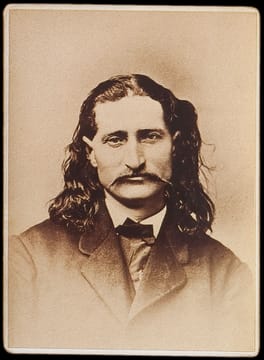
Photo: unattributed / Public domain (source: Wikimedia Commons)
Public records list Wild Bill Hickok as a poker player, gunfighter and gold miner. Wild Bill Hickok was born in Troy Grove, Illinois, United States on May 27, 1837. Death is recorded on August 2, 1876, at the age of 39. Awards on record include Poker Hall of Fame (1979).
My Take
Wild Bill Hickok is one of those rare people who was already a living legend before he hit forty — and then made himself immortal by dying in the most dramatically ironic way possible. Scout, lawman, gambler, showman: the man somehow squeezed about five frontier careers into less than four decades on earth. What really gets me is the Dead Man's Hand story — shot from behind mid-poker-game in Deadwood in 1876, holding aces and eights. You genuinely cannot script that. And more than a century later, in 1979, he got inducted into the Poker Hall of Fame, which feels both completely absurd and totally right. He's the template for every rugged Western hero Hollywood ever cooked up, except the original is always messier, stranger, and more interesting than the copies.
This take was written by generative AI, one per person, from publicly reported facts (editorial policy). It is a reading of the record, not reporting.
1. Profile
- Name (English)
- Wild Bill Hickok
- Name (Japanese)
- ワイルド・ビル・ヒコック
- Reading
- わいるど・びる・ひこっく
- Born
- May 27, 1837 – August 2, 1876
- Origin
- Troy Grove, Illinois, United States
- Occupation
- poker player / gunfighter / gold miner / hunter / soldier
- Zodiac / Chinese zodiac
- Gemini / Rooster
2. Background
Awards & achievements
- 1979 Poker Hall of Fame
3. Links
4. About this entry
Tags
- Last updated
Only publicly available facts are listed; non-public or unconfirmed items are omitted. Base data was compiled from Wikidata from June 2026 onward; ages are recalculated daily and deaths are checked against Wikidata on an ongoing basis. English text is machine-assisted (facts translated by Sonnet, "My Take" written by Opus 4.8). The Japanese page is the source of record.
Frequently asked questions
When was Wild Bill Hickok born?
Wild Bill Hickok was born on May 27, 1837.
When did Wild Bill Hickok die?
Wild Bill Hickok died on August 2, 1876, aged 39.
Where was Wild Bill Hickok from?
Wild Bill Hickok was from Troy Grove, Illinois, United States.
What did Wild Bill Hickok do?
Wild Bill Hickok worked as poker player, gunfighter, gold miner, hunter, soldier.
Poker player — see all → · More people from the United States → · More people born on May 27 →