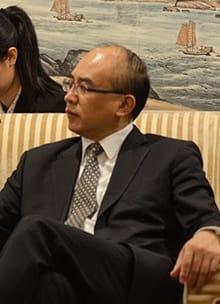
Photo: Eric Garcetti / CC BY 2.0 (source: Wikimedia Commons)
Born on October 1, 1961 in Lianyungang, People's Republic of China, Xu Qin is a politician. As of 2026, Xu Qin is 64 years old. Schooling on record includes Peking University.
My Take
What strikes me about Xu Qin is the arc of his career rather than any single title. From a port city like Lianyungang to Peking University, then steering Shenzhen, China's boldest economic experiment, before moving to Hebei and finally Heilongjiang, he has covered an enormous range of terrain and responsibility. I find the Shenzhen chapter the most telling, because managing that engine of reform demands both vision and nerve. Politicians are usually reduced to their posts, but I am more curious about the judgment forged crossing from coastal boomtowns to the cold industrial north. That breadth, to me, is the real story worth watching.
This take was written by generative AI, one per person, from publicly reported facts (editorial policy). It is a reading of the record, not reporting.
1. Profile
- Name (English)
- Xu Qin
- Name (Japanese)
- 許勤
- Reading
- きょ・きん
- Born
- October 1, 1961 (age 64)
- Origin
- Lianyungang, People's Republic of China
- Occupation
- politician
- Zodiac / Chinese zodiac
- Libra / Ox
2. Background
- University
- Peking University
3. Links
- Wikipedia (English)https://en.wikipedia.org/wiki/Xu%20Qin
- Wikipedia (Japanese)https://ja.wikipedia.org/wiki/%E8%A8%B1%E5%8B%A4
- Wikidatahttps://www.wikidata.org/wiki/Q8462580
4. About this entry
Tags
- Last updated
Facts are limited to publicly available information up to 2024; non-public or unconfirmed items are omitted. English text is machine-assisted (facts translated by Sonnet, "My Take" written by Opus 4.8). The Japanese page is the source of record.
Frequently asked questions
When was Xu Qin born?
Born October 1, 1961 (age 64).
Where is Xu Qin from?
Xu Qin is from Lianyungang, People's Republic of China.
What does Xu Qin do?
Xu Qin works as politician.
Politician — see all → · More people from the People's Republic of China →