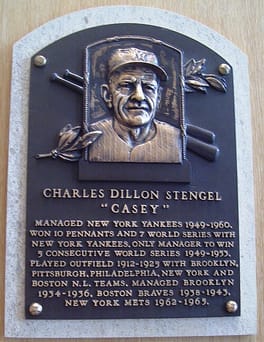
Photo: R on en.wikipedia / Public domain (source: Wikimedia Commons)
Casey Stengel was born on July 30, 1890 in Kansas City, Missouri, United States. Casey Stengel was a baseball player, baseball manager and baseball coach. Death is recorded on September 29, 1975, at the age of 85. Education on record includes Central High School and Metropolitan Community College. Awards on record include No. 1 Award of the National Cartoonists Society.
My Take
Casey Stengel is one of those rare figures who managed to be both completely ridiculous and absolutely brilliant at the same time, and I mean that as the highest compliment. The man spoke in rambling, circular monologues that sportswriters nicknamed "Stengelese," and yet somehow those Yankees teams of the 1950s won five consecutive World Series titles under his watch — a feat that still boggles the mind. He had this gift for handling enormous egos and superstar personalities, getting the best out of Mickey Mantle, Yogi Berra, and Whitey Ford without ever letting the clubhouse get too serious. Then the Mets hired him to manage their disastrous expansion squad, and instead of being embarrassed, he turned the whole mess into something weirdly lovable. Inducted into the Baseball Hall of Fame in 1966, the Ol' Perfessor earned every bit of it.
This take was written by generative AI, one per person, from publicly reported facts (editorial policy). It is a reading of the record, not reporting.
1. Profile
- Name (English)
- Casey Stengel
- Name (Japanese)
- ケーシー・ステンゲル
- Reading
- けーしー・すてんげる
- Born
- July 30, 1890 – September 29, 1975
- Origin
- Kansas City, Missouri, United States
- Occupation
- baseball player / baseball manager / baseball coach
- Zodiac / Chinese zodiac
- Leo / Tiger
2. Background
- High school
- Central High School
- University
- Metropolitan Community College
Awards & achievements
- No. 1 Award of the National Cartoonists Society
3. Links
4. About this entry
Tags
- Last updated
Facts are limited to publicly available information up to 2024; non-public or unconfirmed items are omitted. English text is machine-assisted (facts translated by Sonnet, "My Take" written by Opus 4.8). The Japanese page is the source of record.
Frequently asked questions
When was Casey Stengel born?
Born July 30, 1890.
When did Casey Stengel die?
Died September 29, 1975, aged 85.
Where was Casey Stengel from?
Casey Stengel was from Kansas City, Missouri, United States.
What did Casey Stengel do?
Casey Stengel worked as baseball player, baseball manager, baseball coach.
Baseball player — see all → · Baseball manager — see all → · More people from the United States →