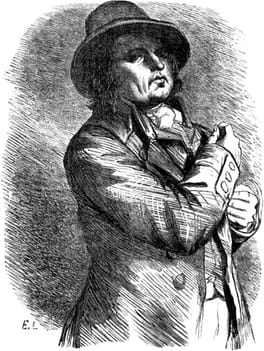
Photo: Eustache Lorsay / Public domain (source: Wikimedia Commons)
Born on February 15, 1739, Charles-Henri Sanson was from Paris, France. Charles-Henri Sanson was credited as an executioner, physician and violinist. Death is recorded on July 4, 1806, at the age of 67.
My Take
Charles-Henri Sanson is one of history's most quietly haunting figures — a man who spent over four decades as Paris's chief executioner and yet, by all accounts, was genuinely troubled by his own profession. He executed somewhere around 3,000 people, including King Louis XVI himself on January 21, 1793, and later Marie Antoinette. What gets me is the contradiction at his core: he was also a trained physician and a violin player, someone with a gentle, cultivated interior life, who nonetheless showed up every morning to do a job that would have broken most people. He reportedly appealed to Louis XVI to abolish the death penalty — while being the man who carried it out. That tension between duty, conscience, and craft feels almost Shakespearean, and honestly more compelling than half the fictional anti-heroes we celebrate today.
This take was written by generative AI, one per person, from publicly reported facts (editorial policy). It is a reading of the record, not reporting.
1. Profile
- Name (English)
- Charles-Henri Sanson
- Name (Japanese)
- シャルル=アンリ・サンソン
- Reading
- しゃるる=あんり・さんそん
- Born
- February 15, 1739 – July 4, 1806
- Origin
- Paris, France
- Occupation
- executioner / physician / violinist
- Zodiac / Chinese zodiac
- Aquarius / Goat
2. Links
3. About this entry
Tags
- Last updated
Only publicly available facts are listed; non-public or unconfirmed items are omitted. Base data was compiled from Wikidata from June 2026 onward; ages are recalculated daily and deaths are checked against Wikidata on an ongoing basis. English text is machine-assisted (facts translated by Sonnet, "My Take" written by Opus 4.8). The Japanese page is the source of record.
Frequently asked questions
When was Charles-Henri Sanson born?
Charles-Henri Sanson was born on February 15, 1739.
When did Charles-Henri Sanson die?
Charles-Henri Sanson died on July 4, 1806, aged 67.
Where was Charles-Henri Sanson from?
Charles-Henri Sanson was from Paris, France.
What did Charles-Henri Sanson do?
Charles-Henri Sanson worked as executioner, physician, violinist.
Physician — see all → · More people from France → · More people born on February 15 →