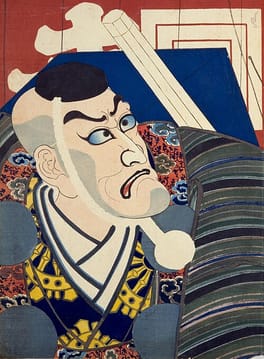
Photo: Unknown author / Public domain (source: Wikimedia Commons)
My Take
Honestly, the moment I heard the name Ichikawa Danjūrō VII, I sat up a little straighter — this is one of the heaviest names in all of kabuki history, and this man carried it through one of Japan's most turbulent centuries, born in the Kansei era and dying on the cusp of the Meiji upheaval. The Danjūrō line basically invented what we think of as bold, swaggering kabuki — the aragoto style, all ferocity and painted faces and poses that stop time — and the seventh generation was right in the thick of the Edo golden age when the theaters were packed and the pit would roar "Naritaya!" at a well-landed mie pose. He was on stage as a child, which tells you everything: this wasn't a career he chose, it was a life he was born into and apparently lived fully. I never got to see any of it, obviously, but the lineage he was part of is the reason kabuki is still alive and still electric today, and that's no small thing to leave behind.
This take was written by generative AI, one per person, from publicly reported facts (editorial policy). It is a reading of the record, not reporting.
Overview
Ichikawa Danjuro VII was a Japanese kabuki actor born in Edo in 1791, and was active during the late Edo period. He bore one of the most prestigious hereditary stage names in kabuki, the Ichikawa Danjuro lineage, and performed from childhood. He died on March 23, 1859, just before the Meiji Restoration, having spent his career in the theatres of Edo.
1. Profile
- Name (English)
- Ichikawa Danjuro VII
- Name (Japanese)
- 七代目 市川團十郎
- Reading
- いちかわ だんじゅうろう
- Born
- 1791 – March 23, 1859
- Origin
- Edo (present-day Tokyo), Japan
- Occupation
- Kabuki actor / Child actor
- Zodiac / Chinese zodiac
- Boar
2. Links
3. About this entry
Tags
- Last updated
Only publicly available facts are listed; non-public or unconfirmed items are omitted. Base data was compiled from Wikidata from June 2026 onward; ages are recalculated daily and deaths are checked against Wikidata on an ongoing basis. English text is machine-assisted (facts translated by Sonnet, "My Take" written by Opus 4.8). The Japanese page is the source of record.
Frequently asked questions
Where was Ichikawa Danjuro VII from?
Ichikawa Danjuro VII was from Edo (present-day Tokyo), Japan.
What did Ichikawa Danjuro VII do?
Ichikawa Danjuro VII worked as Kabuki actor, Child actor.
Kabuki actor — see all → · Child actor — see all → · More people from Japan →