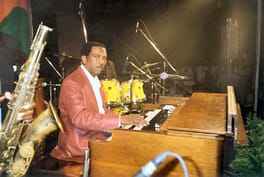
Photo: Hammondite / CC BY 3.0 (source: Wikimedia Commons)
Jimmy Smith was an organist, pianist and jazz musician. Jimmy Smith was born on December 8, 1928 in Norristown, Pennsylvania, United States. Death is recorded on February 8, 2005, at the age of 76. Listed accolades include NEA Jazz Masters.
My Take
Jimmy Smith is the reason the Hammond B-3 organ is a jazz instrument at all — before him, it was basically a church and novelty curiosity, and he turned it into something that could swing, burn, and flat-out cook with the best of them. Growing up in Norristown, Pennsylvania, he had serious piano chops first, and that foundation is all over his playing: the left hand walking bass lines, the right hand lines that think like a horn. His Blue Note recordings from the late 1950s — things like "The Sermon" stretching out past twenty minutes — are just staggering, and his crossover into soul jazz in the 1960s gave the whole genre a grittier, earthier pulse. He earned the NEA Jazz Masters Award in 2005, the year he died, which feels bittersweet but fitting. The man basically invented a vocabulary that everyone from Groove Holmes to Larry Young to Joey DeFrancesco had to reckon with. Absolutely essential.
This take was written by generative AI, one per person, from publicly reported facts (editorial policy). It is a reading of the record, not reporting.
1. Profile
- Name (English)
- Jimmy Smith
- Name (Japanese)
- ジミー・スミス
- Reading
- じみー・すみす
- Born
- December 8, 1928 – February 8, 2005
- Origin
- Norristown, Pennsylvania, United States
- Occupation
- organist / pianist / jazz musician / recording artist / composer
- Zodiac / Chinese zodiac
- Sagittarius / Dragon
2. Background
Awards & achievements
- NEA Jazz Masters
3. Links
- Wikipedia (English)https://en.wikipedia.org/wiki/Jimmy%20Smith%20(musician)
- Wikipedia (Japanese)https://ja.wikipedia.org/wiki/%E3%82%B8%E3%83%9F%E3%83%BC%E3%83%BB%E3%82%B9%E3%83%9F%E3%82%B9
- Wikidatahttps://www.wikidata.org/wiki/Q318948
4. About this entry
Tags
- Last updated
Only publicly available facts are listed; non-public or unconfirmed items are omitted. Base data was compiled from Wikidata from June 2026 onward; ages are recalculated daily and deaths are checked against Wikidata on an ongoing basis. English text is machine-assisted (facts translated by Sonnet, "My Take" written by Opus 4.8). The Japanese page is the source of record.
Frequently asked questions
When was Jimmy Smith born?
Jimmy Smith was born on December 8, 1928.
When did Jimmy Smith die?
Jimmy Smith died on February 8, 2005, aged 76.
Where was Jimmy Smith from?
Jimmy Smith was from Norristown, Pennsylvania, United States.
What did Jimmy Smith do?
Jimmy Smith worked as organist, pianist, jazz musician, recording artist, composer.
Organist — see all → · Pianist — see all → · More people from the United States → · More people born on December 8 →