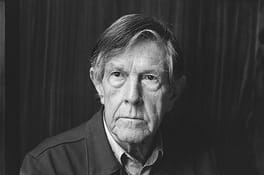
Photo: Rob Bogaerts / Anefo / CC0 (source: Wikimedia Commons)
John Cage was born on September 5, 1912 in Los Angeles, California, United States and was credited as a composer, writer and poet. John Cage died on August 12, 1992 at the age of 79. Education on record includes Los Angeles High School and University of California, Los Angeles. Awards on record include Guggenheim Fellowship (1949), Kyoto Prize in Arts and Philosophy (1989), Fellow of the American Academy of Arts and Sciences and 2 more. Credited works include The Perilous Night, Two² and In the Name of the Holocaust.
My Take
Honestly, the first time I heard about 4′33″ — you know, the piece where the performer sits at the piano and plays absolutely nothing for four minutes and thirty-three seconds — my reaction was somewhere between baffled and annoyed. But that's exactly the trap Cage set, and he got me good. The whole point is that silence doesn't exist: every cough from the audience, every creak of a chair, every car passing outside becomes the music. That's a genuinely mind-bending idea, and he spent a lifetime building the philosophy to back it up — through prepared piano (shoving screws and rubber into the strings of a Steinway and making it sound like a gamelan), through chance operations drawn from the I Ching, through his deep friendship with Merce Cunningham that blurred the line between music and dance. He was a Los Angeles kid who ended up changing how the entire world thinks about sound, won a Guggenheim at 36 and the Kyoto Prize at 76, and never once played it safe. A true original, and I mean that without irony.
This take was written by generative AI, one per person, from publicly reported facts (editorial policy). It is a reading of the record, not reporting.
1. Profile
- Name (English)
- John Cage
- Name (Japanese)
- ジョン・ケージ
- Reading
- じょん・けーじ
- Born
- September 5, 1912 – August 12, 1992
- Origin
- Los Angeles, California, United States
- Occupation
- composer / writer / poet / university teacher / musicologist
- Zodiac / Chinese zodiac
- Virgo / Rat
2. Background
- High school
- Los Angeles High School
- University
- University of California, Los Angeles
Awards & achievements
- 1949 Guggenheim Fellowship
- 1989 Kyoto Prize in Arts and Philosophy
- Fellow of the American Academy of Arts and Sciences
- 1949 Arts and Letters Award in Music
- Honorary Member of the International Society for Contemporary Music
3. Works & records
Filmography / notable works
| Category | Title |
|---|---|
| Notable work | The Perilous Night |
| Notable work | Two² |
| Notable work | In the Name of the Holocaust |
| Notable work | Bacchanale |
| Notable work | 4′33″ |
| Notable work | Sonatas and Interludes |
4. Links
- Official sitehttps://johncage.org
- Wikipedia (English)https://en.wikipedia.org/wiki/John%20Cage
- Wikipedia (Japanese)https://ja.wikipedia.org/wiki/%E3%82%B8%E3%83%A7%E3%83%B3%E3%83%BB%E3%82%B1%E3%83%BC%E3%82%B8
- Wikidatahttps://www.wikidata.org/wiki/Q180727
5. About this entry
Tags
- Last updated
Only publicly available facts are listed; non-public or unconfirmed items are omitted. Base data was compiled from Wikidata from June 2026 onward; ages are recalculated daily and deaths are checked against Wikidata on an ongoing basis. English text is machine-assisted (facts translated by Sonnet, "My Take" written by Opus 4.8). The Japanese page is the source of record.
Frequently asked questions
When was John Cage born?
John Cage was born on September 5, 1912.
When did John Cage die?
John Cage died on August 12, 1992, aged 79.
Where was John Cage from?
John Cage was from Los Angeles, California, United States.
What did John Cage do?
John Cage worked as composer, writer, poet, university teacher, musicologist.
Where did John Cage study?
John Cage attended University of California, Los Angeles.
What was John Cage known for?
John Cage's notable works include The Perilous Night, Two², In the Name of the Holocaust.
Composer — see all → · Writer — see all → · More people from the United States → · More people born on September 5 →