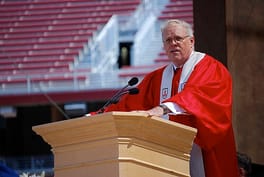
Photo: Eric Chan / CC BY 2.0 (source: Wikimedia Commons)
John L. Hennessy was born on September 22, 1952 in Huntington, New York, United States. John L. Hennessy is listed as a computer scientist, engineer and university teacher. The age as of 2026 is 73. Education on record includes Stony Brook University. Awards on record include IEEE John von Neumann Medal (2000), IEEE Medal of Honor (2012), IEEE Emanuel R. Piore Award (1994) and 5 more.
My Take
John Hennessy sits in a category of his own for me. A Turing Award laureate who also ran Stanford for sixteen years, he managed to reach the summit as both scholar and leader, a genuine rarity. As a co-founder of MIPS and Atheros and now chairman of Alphabet, he straddles research, entrepreneurship and institutional power with unusual grace. The computer architecture ideas he helped shape quietly underpin the devices we touch every day. There is nothing showy about him, and that is exactly the point. When people speak of a giant of the field with real humility, Hennessy is the figure I picture.
This take was written by generative AI, one per person, from publicly reported facts (editorial policy). It is a reading of the record, not reporting.
1. Profile
- Name (English)
- John L. Hennessy
- Name (Japanese)
- ジョン・ヘネシー
- Reading
- じょん・へねしー
- Born
- September 22, 1952 (age 73)
- Origin
- Huntington, New York, United States
- Occupation
- computer scientist / engineer / university teacher / businessperson / academic
- Zodiac / Chinese zodiac
- Virgo / Dragon
2. Background
- University
- Stony Brook University
Awards & achievements
- 2000 IEEE John von Neumann Medal
- 2012 IEEE Medal of Honor
- 1994 IEEE Emanuel R. Piore Award
- Computer History Museum Fellow
- 2001 Eckert–Mauchly Award
- 2001 Seymour Cray Computer Engineering Award
- 2017 Turing Award
- 2002 honorary doctor of the University Polytechnic of Catalonia
3. Links
- Official sitehttps://profiles.stanford.edu/john-hennessy
- Wikipedia (English)https://en.wikipedia.org/wiki/John%20L.%20Hennessy
- Wikipedia (Japanese)https://ja.wikipedia.org/wiki/%E3%82%B8%E3%83%A7%E3%83%B3%E3%83%BB%E3%83%98%E3%83%8D%E3%82%B7%E3%83%BC
- Wikidatahttps://www.wikidata.org/wiki/Q92854
4. About this entry
Tags
- Last updated
Facts are limited to publicly available information up to 2024; non-public or unconfirmed items are omitted. English text is machine-assisted (facts translated by Sonnet, "My Take" written by Opus 4.8). The Japanese page is the source of record.
Frequently asked questions
When was John L. Hennessy born?
Born September 22, 1952 (age 73).
Where is John L. Hennessy from?
John L. Hennessy is from Huntington, New York, United States.
What does John L. Hennessy do?
John L. Hennessy works as computer scientist, engineer, university teacher, businessperson, academic.
Computer scientist — see all → · Engineer — see all → · More people from the United States →