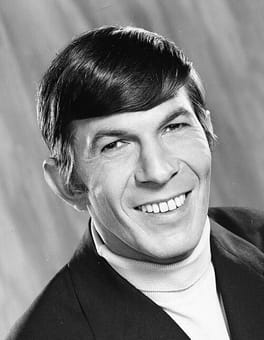
Photo: CBS Television / Public domain (source: Wikimedia Commons)
Leonard Nimoy was born on March 26, 1931 in West End, Massachusetts, United States and was credited as a television actor, film actor and film director. Leonard Nimoy died on February 27, 2015, aged 83. Education on record includes Boston English High School and Antioch University. Listed accolades include star on Hollywood Walk of Fame and Saturn Award for Best Guest Starring Role on Television (2010). Credited works include Vulcan salute.
My Take
Leonard Nimoy carried a burden few actors ever face: a single role so iconic it threatened to swallow the man entirely. What moves me is how he resolved that tension. After years of wrestling with Spock, he ultimately embraced him, directing Star Trek films, writing poetry, and making photographs, proving an artist can contain both logic and feeling, just like the character. The Vulcan salute he adapted from a Jewish blessing is now a universal gesture of goodwill, which says everything about his cultural reach. Nimoy died in 2015, but I would argue no actor has ever turned typecasting into a richer, more generous legacy.
This take was written by generative AI, one per person, from publicly reported facts (editorial policy). It is a reading of the record, not reporting.
1. Profile
- Name (English)
- Leonard Nimoy
- Name (Japanese)
- レナード・ニモイ
- Reading
- れなーど・にもい
- Born
- March 26, 1931 – February 27, 2015
- Origin
- West End, Massachusetts, United States
- Occupation
- television actor / film actor / film director / poet / writer
- Zodiac / Chinese zodiac
- Aries / Goat
2. Background
- High school
- Boston English High School
- University
- Antioch University
Awards & achievements
- star on Hollywood Walk of Fame
- 2010 Saturn Award for Best Guest Starring Role on Television
3. Works & records
Filmography / notable works
| Category | Title |
|---|---|
| Notable work | Vulcan salute |
4. Links
- Official sitehttp://www.LeonardNimoyPhotography.com/
- Xhttps://x.com/TheRealNimoy
- Wikipedia (English)https://en.wikipedia.org/wiki/Leonard%20Nimoy
- Wikipedia (Japanese)https://ja.wikipedia.org/wiki/%E3%83%AC%E3%83%8A%E3%83%BC%E3%83%89%E3%83%BB%E3%83%8B%E3%83%A2%E3%82%A4
- Wikidatahttps://www.wikidata.org/wiki/Q16345
5. About this entry
Tags
- Last updated
Facts are limited to publicly available information up to 2024; non-public or unconfirmed items are omitted. English text is machine-assisted (facts translated by Sonnet, "My Take" written by Opus 4.8). The Japanese page is the source of record.
Frequently asked questions
When was Leonard Nimoy born?
Born March 26, 1931.
When did Leonard Nimoy die?
Died February 27, 2015, aged 83.
Where was Leonard Nimoy from?
Leonard Nimoy was from West End, Massachusetts, United States.
What did Leonard Nimoy do?
Leonard Nimoy worked as television actor, film actor, film director, poet, writer.
What was Leonard Nimoy known for?
Notable works include Vulcan salute.
Television actor — see all → · Film actor — see all → · More people from the United States →