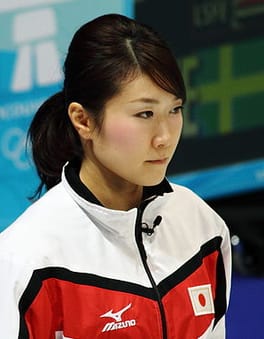
Photo: Womens_Curling_Team_Japan.jpg: Chase N. from Marysville, WA, USA derivative work: Runmatze (talk) / CC BY-SA 2.0 (source: Wikimedia Commons)
My Take
Growing up in Minami-Furano — a town so far into Hokkaido's interior that ice and snow aren't a season, they're just the default setting — it almost feels inevitable that Moe Meguro ended up on a curling sheet. Born in 1984, she's part of a generation that quietly built Japanese women's curling into something the rest of the world had to start taking seriously. What I respect most is that she made it to Hirosaki University while competing, which tells you this wasn't just raw talent coasting on cold weather and luck. Curling gets a lot of fair-weather fans during the Winter Olympics when everyone suddenly becomes an expert on the skip's calls, but the athletes who actually grind through the off-years and low-spotlight seasons are the ones who built the sport. Meguro is exactly that kind of player.
This take was written by generative AI, one per person, from publicly reported facts (editorial policy). It is a reading of the record, not reporting.
Overview
Moe Meguro is a Japanese former curler born on November 20, 1984, in Kushiro, Hokkaido, and raised in Minami-Furano. She attended Hirosaki University, balancing her academic studies with her athletic career. She represented Japan at the 2006 Turin and 2010 Vancouver Olympics before retiring in 2010.
1. Profile
- Name (English)
- Moe Meguro
- Name (Japanese)
- 目黒萌絵
- Reading
- めぐろ もえ
- Born
- November 20, 1984 (age 41)
- Origin
- Minami-Furano, Hokkaido, Japan
- Height
- 163 cm
- Occupation
- Curler
- Zodiac / Chinese zodiac
- Scorpio / Rat
2. Background
- University
- Hirosaki University
3. Links
- Wikipedia (Japanese)https://ja.wikipedia.org/wiki/%E7%9B%AE%E9%BB%92%E8%90%8C%E7%B5%B5
- Wikidatahttps://www.wikidata.org/wiki/Q457323
4. About this entry
Tags
- Last updated
Only publicly available facts are listed; non-public or unconfirmed items are omitted. Base data was compiled from Wikidata from June 2026 onward; ages are recalculated daily and deaths are checked against Wikidata on an ongoing basis. English text is machine-assisted (facts translated by Sonnet, "My Take" written by Opus 4.8). The Japanese page is the source of record.
Frequently asked questions
When was Moe Meguro born?
Moe Meguro was born on November 20, 1984 and is 41 years old.
Where is Moe Meguro from?
Moe Meguro is from Minami-Furano, Hokkaido, Japan.
What does Moe Meguro do?
Moe Meguro works as Curler.
How tall is Moe Meguro?
Moe Meguro is 163 cm tall.
Where did Moe Meguro study?
Moe Meguro attended Hirosaki University.
More people from Japan → · More people born on November 20 →