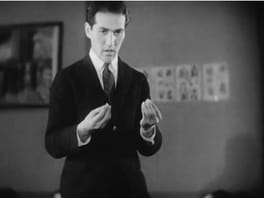
Photo: 松竹キネマ / Public domain (source: Wikimedia Commons)
My Take
Seiji Nishimura is one of those figures who exists at the edge of memory — born in 1906 in Otaru, Hokkaido, he came of age in the Taisho era when Japanese cinema was still finding its footing and stage acting meant something raw and physical. He died in 1948, only in his early forties, which means his entire career played out across one of the most turbulent stretches of modern Japanese history — the rise of talkies, wartime, the whole upheaval. He started as a leading man at Toa Kinema under the name Kinnosuke Hyuga, then spent nearly two decades as a supporting player at Shochiku's Kamata and Ofuna studios, right through wartime and into 1948. Many of his early silent films no longer survive, which is what happened to a lot of working actors from that generation, guys who showed up, did the work, and got swallowed by time. I find myself wanting to know what his face looked like on screen.
This take was written by generative AI, one per person, from publicly reported facts (editorial policy). It is a reading of the record, not reporting.
Overview
Seiji Nishimura (1906–1948) was a Japanese actor born in Otaru, Hokkaido. Active during the Taisho and early Showa eras, he worked as a performer at a time when Japanese cinema and theatre were still developing their modern forms. He died in 1948. After middle school in Otaru he joined the Toa Kinema studio in 1924, playing leading and second-lead roles under the name Kinnosuke Hyuga, then moved to Shochiku's Kamata studio in 1930, took the name Seiji Nishimura and worked as a supporting actor there and at Ofuna until 1948.
1. Profile
- Name (English)
- Seiji Nishimura
- Name (Japanese)
- 西村青児
- Reading
- にしむら せいじ
- Born
- March 30, 1906 – 1948
- Origin
- Otaru, Hokkaido, Japan
- Occupation
- Actor
- Zodiac / Chinese zodiac
- Aries / Horse
2. Links
- Wikipedia (Japanese)https://ja.wikipedia.org/wiki/%E8%A5%BF%E6%9D%91%E9%9D%92%E5%85%90
- Wikidatahttps://www.wikidata.org/wiki/Q11628691
3. About this entry
Tags
- Last updated
Only publicly available facts are listed; non-public or unconfirmed items are omitted. Base data was compiled from Wikidata from June 2026 onward; ages are recalculated daily and deaths are checked against Wikidata on an ongoing basis. English text is machine-assisted (facts translated by Sonnet, "My Take" written by Opus 4.8). The Japanese page is the source of record.
Frequently asked questions
When was Seiji Nishimura born?
Seiji Nishimura was born on March 30, 1906.
When did Seiji Nishimura die?
Seiji Nishimura died on 1948.
Where was Seiji Nishimura from?
Seiji Nishimura was from Otaru, Hokkaido, Japan.
What did Seiji Nishimura do?
Seiji Nishimura worked as Actor.
Actor — see all → · More people from Japan → · More people born on March 30 →