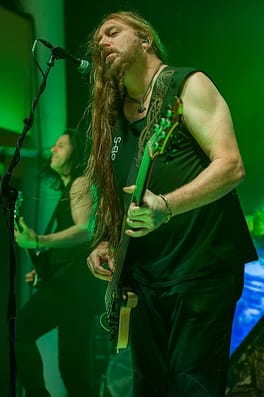
Photo: Stefan Brending (2eight) / CC BY-SA 3.0 de (source: Wikimedia Commons)
Born on November 7, 1967, Steve DiGiorgio is from Waukegan, Illinois, United States. Steve DiGiorgio is a bass guitarist, record producer and session musician. The age as of 2026 is 58.
My Take
Steve DiGiorgio is the kind of musician I deeply admire precisely because most casual listeners have never heard his name. As a bassist he's played on over fifty albums, working with Death, Testament, Sadus, which he co-founded, plus Iced Earth, Obituary and many more. What strikes me is his fretless bass approach in extreme metal, a context where bass usually just rumbles in the back. He brought genuine melodicism and fluidity to brutal music. The Illinois-born session veteran is a musician's musician, the player other players name-check. His discography reads like a tour through metal's most uncompromising corners.
This take was written by generative AI, one per person, from publicly reported facts (editorial policy). It is a reading of the record, not reporting.
1. Profile
- Name (English)
- Steve DiGiorgio
- Name (Japanese)
- スティーブ・ディ・ジョージオ
- Reading
- すてぃーぶ・でぃ・じょーじお
- Born
- November 7, 1967 (age 58)
- Origin
- Waukegan, Illinois, United States
- Occupation
- bass guitarist / record producer / session musician / guitarist / musician
- Zodiac / Chinese zodiac
- Scorpio / Goat
2. Links
- Official sitehttp://www.stevedigiorgio.com
- Wikipedia (English)https://en.wikipedia.org/wiki/Steve%20Di%20Giorgio
- Wikipedia (Japanese)https://ja.wikipedia.org/wiki/%E3%82%B9%E3%83%86%E3%82%A3%E3%83%BC%E3%83%B4%E3%83%BB%E3%83%87%E3%82%A3%E3%82%B8%E3%83%A7%E3%83%AB%E3%82%B8%E3%82%AA
- Wikidatahttps://www.wikidata.org/wiki/Q728753
3. About this entry
Tags
- Last updated
Facts are limited to publicly available information up to 2024; non-public or unconfirmed items are omitted. English text is machine-assisted (facts translated by Sonnet, "My Take" written by Opus 4.8). The Japanese page is the source of record.
Frequently asked questions
When was Steve DiGiorgio born?
Born November 7, 1967 (age 58).
Where is Steve DiGiorgio from?
Steve DiGiorgio is from Waukegan, Illinois, United States.
What does Steve DiGiorgio do?
Steve DiGiorgio works as bass guitarist, record producer, session musician, guitarist, musician.
Bass guitarist — see all → · Record producer — see all → · More people from the United States →