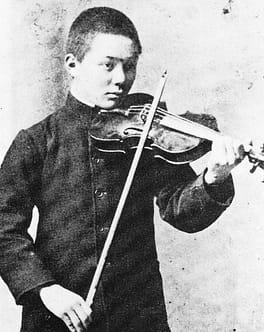
Photo: Unknown author / Public domain (source: Wikimedia Commons)
My Take
Tamezō Narita was born in 1893 in the snowy, remote northern reaches of Akita Prefecture, and just that detail alone makes me stop and think. To grow up that far from any cultural center in Meiji-era Japan and still find your way toward music composition — that takes a particular kind of stubborn inner drive. He worked through an era of enormous upheaval, from the Meiji reforms through two world wars, and he died in October 1945, just weeks after the war ended, at only 51. There's something quietly devastating about that timing. He never got to see what came after. He left songs like "Hamabe no Uta" and studied counterpoint in Berlin, and though most of his orchestral work was lost in the air raids, I find myself genuinely moved by the image of someone in that era, in that place, just sitting with sheet music and trying to make something beautiful — not for fame, just because the melodies were there and needed to exist.
This take was written by generative AI, one per person, from publicly reported facts (editorial policy). It is a reading of the record, not reporting.
Overview
Tamezō Narita (1893–1945) was a Japanese composer born in Kitaakita District, Akita Prefecture. He is remembered as one of the composers of the Meiji and Taisho eras who contributed to the development of Japanese Western-style music. He died on October 29, 1945, at the age of 51, the same year World War II ended.
1. Profile
- Name (English)
- Tamezō Narita
- Name (Japanese)
- 成田為三
- Reading
- なりた ためぞう
- Born
- December 15, 1893 – October 29, 1945
- Origin
- Kitaakita District, Akita Prefecture, Japan
- Occupation
- Composer
- Zodiac / Chinese zodiac
- Sagittarius / Snake
- Active years
- 1916 - 1945
2. Works & records
Works summary
- Works
- 45
- By year (titles with a known year)
- 1965: 1, year unknown: 44
Filmography / notable works
| Title | Year |
|---|---|
| さくら | 1965 |
| 二つのローマンス | |
| 東亜の光 | |
| ヴァイオリンとピアノのためのカノン ト長調 | |
| メヌエット | |
| ロンド ロ短調 | |
| フーゲ ハ長調 | |
| 四季 | |
| 秋 - 月を仰ぎ ハ短調 | |
| フーゲ ト長調 | |
| ピアノソナタ ト短調 第1楽章 | |
| 浜辺の歌 | |
| ロンド ト短調 | |
| 君が代 | |
| 望郷の歌 | |
| 清怨 | |
| 赤い鳥小鳥 | |
| 犬のお芝居 | |
| かなりや | |
| りすりすこりす | |
| はっぱ | |
| みのり | |
| 昼と夜と | |
| とこしへに | |
| 松島や | |
| 敷島の | |
| 月 | |
| 母よ、さらば | |
| 梅花 | |
| 秋田おばこ | |
| 庄内おばこ | |
| 佐渡おけさ | |
| うらうらと | |
| 見渡せば | |
| すみれ | |
| ほろほろと | |
| 不盡山を望みて | |
| 秋田県民歌 | |
| 能代市立渟城第一小学校校歌 | |
| 秋田県大仙市立太田南小学校校歌 | |
| 秋田市立秋田商業高等学校校歌 | |
| 秋田県立能代北高等学校校歌 | |
| 聖霊女子短期大学付属高等学校校歌 | |
| 前田村 | |
| 川村学園学園歌 |
3. Links
- Wikipedia (Japanese)https://ja.wikipedia.org/wiki/%E6%88%90%E7%94%B0%E7%82%BA%E4%B8%89
- Wikidatahttps://www.wikidata.org/wiki/Q7681184
4. About this entry
Tags
- Last updated
Only publicly available facts are listed; non-public or unconfirmed items are omitted. Base data was compiled from Wikidata from June 2026 onward; ages are recalculated daily and deaths are checked against Wikidata on an ongoing basis. Works and profile fields sourced from Wikipedia reflect content as of 2026-08-26. English text is machine-assisted (facts translated by Sonnet, "My Take" written by Opus 4.8). The Japanese page is the source of record.
Frequently asked questions
When was Tamezō Narita born?
Tamezō Narita was born on December 15, 1893.
When did Tamezō Narita die?
Tamezō Narita died on October 29, 1945, aged 51.
Where was Tamezō Narita from?
Tamezō Narita was from Kitaakita District, Akita Prefecture, Japan.
What did Tamezō Narita do?
Tamezō Narita worked as Composer.
When was Tamezō Narita active?
Tamezō Narita was active from 1916 to 1945.
Composer — see all → · More people from Japan → · More people born on December 15 →