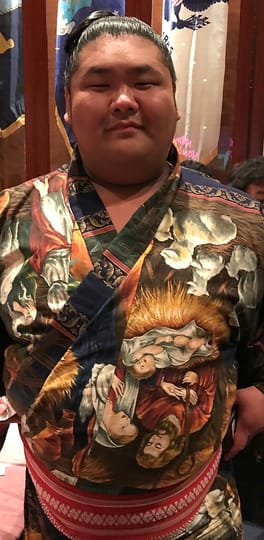
Photo: FourTildes / CC BY-SA 4.0 (source: Wikimedia Commons)
My Take
Akua Shoma is the kind of sumo story that doesn't get nearly enough attention — a guy from a small coastal town in Ibaraki who spent a full decade grinding through the lower divisions before finally breaking into makuuchi in his thirties. That alone earns serious respect; most wrestlers either make it young or quietly fade out, but Akua just kept showing up. He never cracked sanyaku, topping out around West Maegashira 10, but what really sticks with me is what came after his top-division run: he pivoted into the yumitori role — that ceremonial bow twirling at the end of tournament days — joining a very short list of former makuuchi wrestlers to take it on since daily ceremonies began in 1952. That's a genuinely rare footnote, the kind of weird-but-meaningful legacy that suits someone who always seemed to do sumo on his own timeline anyway.
This take was written by generative AI, one per person, from publicly reported facts (editorial policy). It is a reading of the record, not reporting.
Overview
Akua Shōma (天空海翔馬) is a Japanese professional sumo wrestler born on November 6, 1990, in Oarai, Ibaraki Prefecture, Japan. He is active on social media and maintains public Instagram and X accounts. Wrestling for Tatsunami stable, he debuted in November 2010, reached the top makuuchi division in November 2020 with a highest rank of West Maegashira 10, and performed the bow-twirling ceremony (yumitori) in 2025.
1. Profile
- Name (English)
- Akua Shōma
- Name (Japanese)
- 天空海翔馬
- Reading
- あくあ しょうま
- Real name
- 高畠祐貴
- Born
- November 6, 1990 (age 35)
- Origin
- Oarai, Ibaraki, Japan
- Occupation
- Sumo wrestler
- Zodiac / Chinese zodiac
- Scorpio / Horse
2. Links
3. About this entry
Tags
- Last updated
Only publicly available facts are listed; non-public or unconfirmed items are omitted. Base data was compiled from Wikidata from June 2026 onward; ages are recalculated daily and deaths are checked against Wikidata on an ongoing basis. English text is machine-assisted (facts translated by Sonnet, "My Take" written by Opus 4.8). The Japanese page is the source of record.
Frequently asked questions
When was Akua Shōma born?
Akua Shōma was born on November 6, 1990 and is 35 years old.
Where is Akua Shōma from?
Akua Shōma is from Oarai, Ibaraki, Japan.
What does Akua Shōma do?
Akua Shōma works as Sumo wrestler.
Sumo wrestler — see all → · More people from Japan → · More people born on November 6 →